Aug 18, 2026
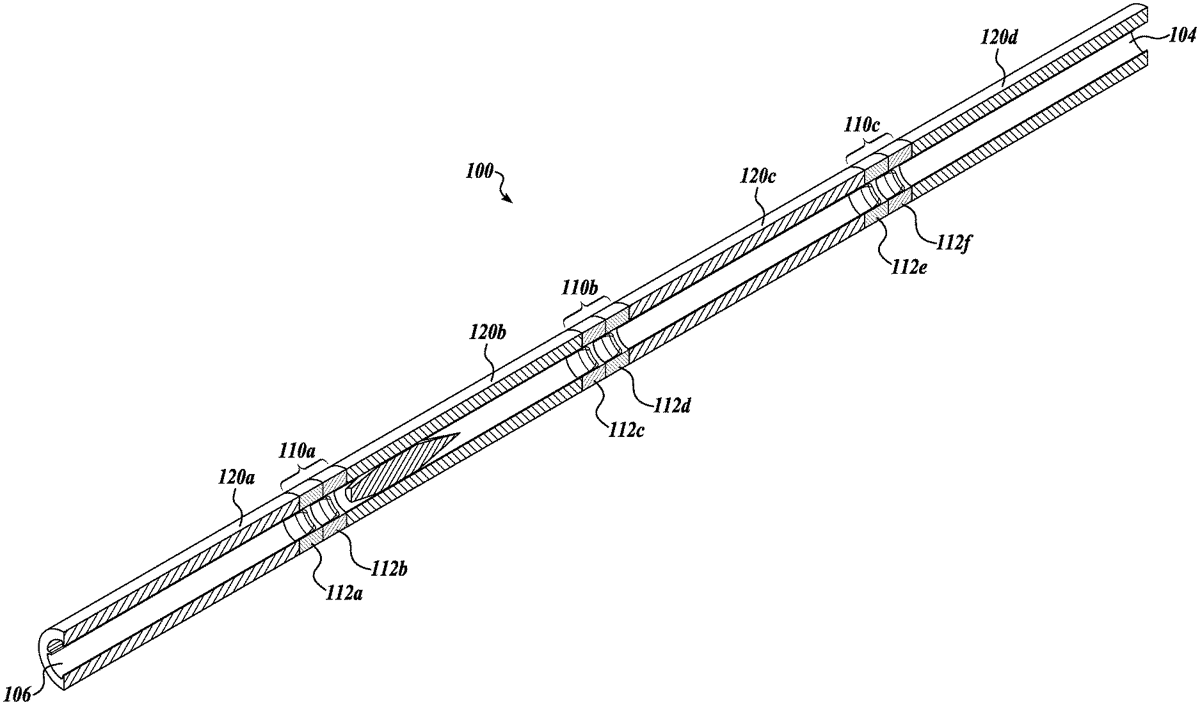
A ram accelerator for accelerating a projectile is provided. The ram accelerator includes a first tube body having a first projectile bore, a second tube body having a second projectile bore axially aligned with the first projectile bore, and a baffle positioned between and operably coupling the first and second tube bodies. The baffle can have an annular baffle wall defining a central bore that is axially aligned with the first and second projectile bores, and a chamber arranged adjacent to the annular baffle wall. The chamber can extend radially outward from the central bore and the annular baffle wall can be configured to sweep a combustion wave relative to the projectile to prevent the combustion wave from traveling ahead of the projectile, leading to an unstart mechanism of the projectile in the ram accelerator.
Aug 11, 2026
A suppressor baffle includes a cone portion expanding along a central axis from a proximal end defining a projectile opening to an open distal end having an outer rim. The projectile opening is in an entrance plane oriented obliquely to the central axis. A first volume between a first side of the cone portion and a central plane that includes the central axis is smaller than a second volume between an opposite second side of the cone portion and the central plane. At least part of the outer surface of the second side of the cone portion has a convex profile as viewed along the central plane from a side of the suppressor baffle. In another example, a first part of the cone is axially offset from an opposite second part of the cone, resulting in a curved projectile opening profile and a curved outer rim profile.
Nov 4, 2025
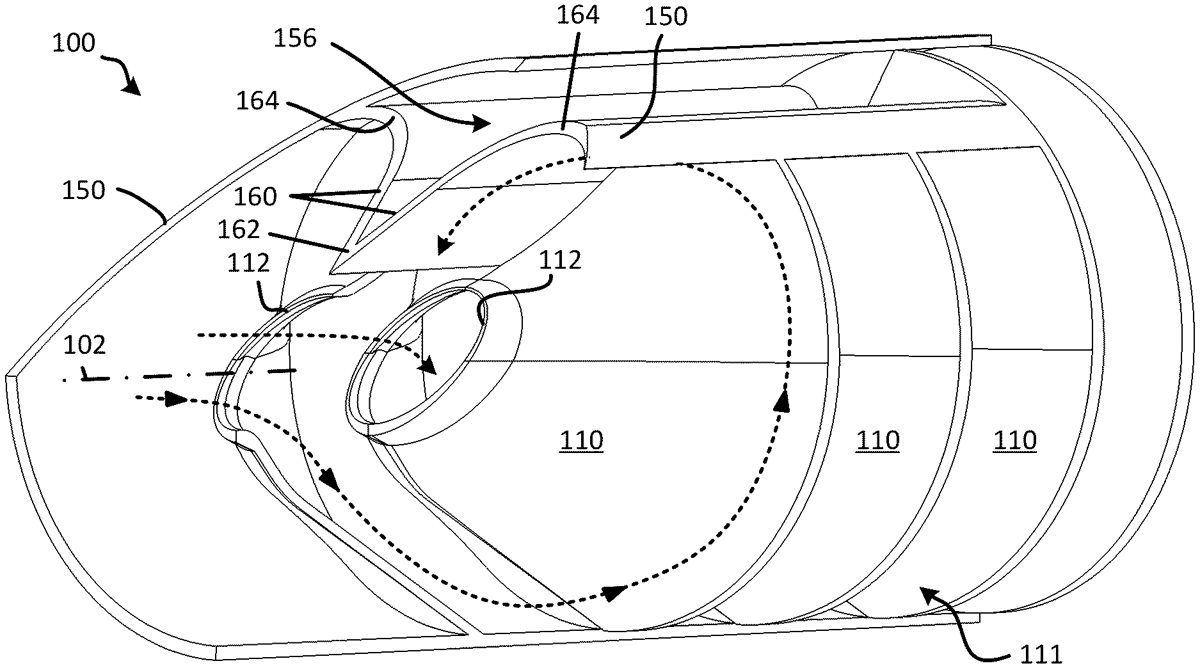
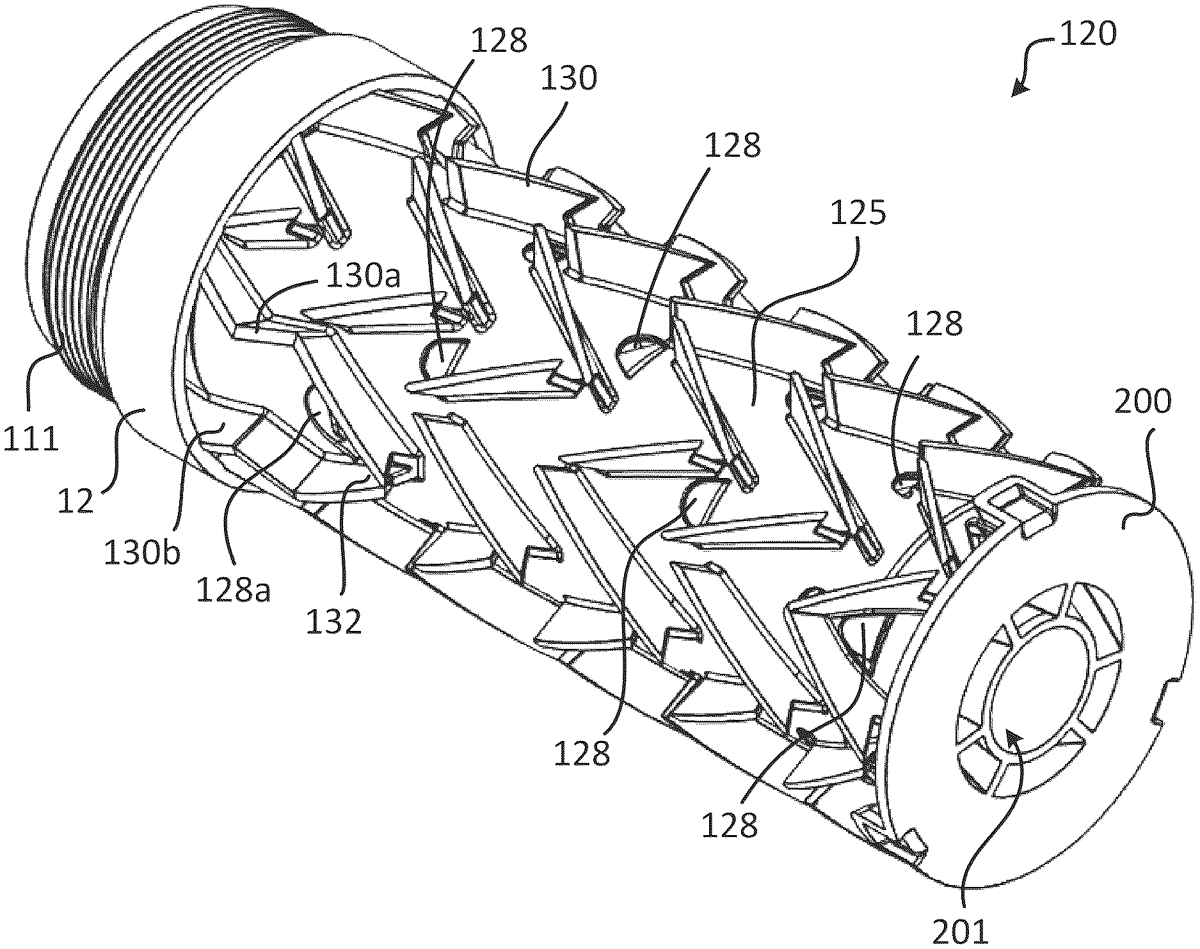
A suppressor for a firearm has a tubular housing extending along a bore axis from a proximal end to a distal end. A baffle stack within the hollow tubular housing extends along the bore axis and includes a tubular baffle wall with a plurality of baffle structures connected to an inside of the tubular baffle wall, where individual baffle structures taper proximally to a central opening on the bore axis. The suppressor defines an inner volume inside of the tubular baffle wall and an outer volume between the tubular baffle wall and the hollow tubular housing. Flow-directing structures in the outer volume include pairs of diverging vanes and pairs of converging vanes. A conduit between adjacent baffle structures defines a gas flow pathway in a radially outer portion of the inner volume and defines an opening located between the adjacent baffle structures to direct gas flow across the bore axis.
Aug 19, 2025
Jul 1, 2025
Provided is a firearm noise suppressor baffle formed of at least two material zones. The zones are made of materials having dissimilar coefficients of thermal expansion from each other and have an interface substantially transverse to a bore axis. The baffle includes an annularly interrupting gap having a width. The gap is formed in at least one of the material zones and extends substantially longitudinal relative to the bore axis from an edge of the baffle.
May 27, 2025
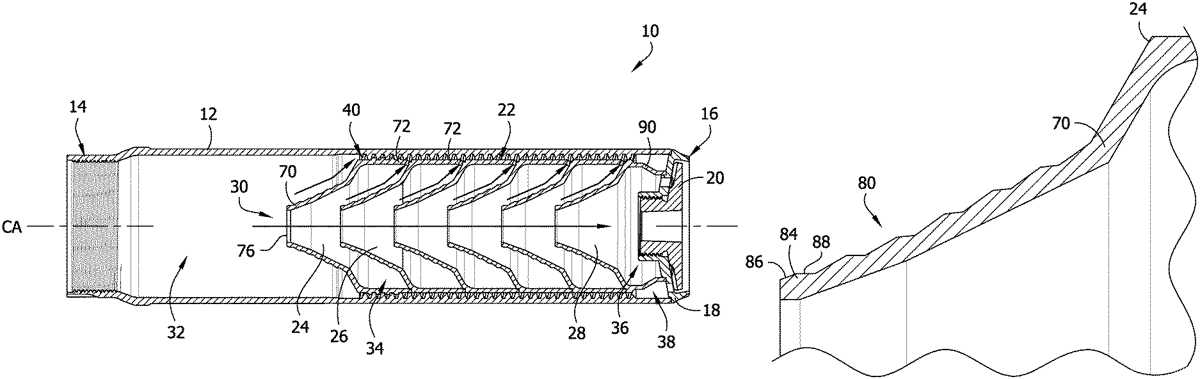
A suppressor baffle and a suppressor for a firearm. The suppressor includes a firearm attachment portion, a sleeve portion, and a baffle assembly with a plurality of baffles. At least one of the baffles includes a tubular body with a proximal exterior surface. The proximal exterior surface has a plurality of spaced-apart annular ridges. A first annular ridge includes a first annular compression surface and a first annular expansion surface, and a second annular ridge includes a second annular compression surface. The ridges are shaped and arranged to define a convex first expansion corner between the first annular compression surface and the first annular expansion surface, and a concave first compression corner between the first annular expansion surface and the second annular compression surface. Gas flowing along the proximal exterior surface expands at the first expansion corner and compresses at the first compression corner to dissipate energy in the gas.