Nov 18, 2025
A firearm suppressor includes a first section along an axis; a second section along the axis downstream of the first section, the second section having a second section twist rate; a third section along the axis downstream of the second section, the third section having a third section twist rate, the third section twist rate greater than the second section twist rate; and a fourth section along the axis downstream of the third section, the fourth section having a fourth section twist rate, the fourth section twist rate greater than the third section twist rate.
Nov 4, 2025
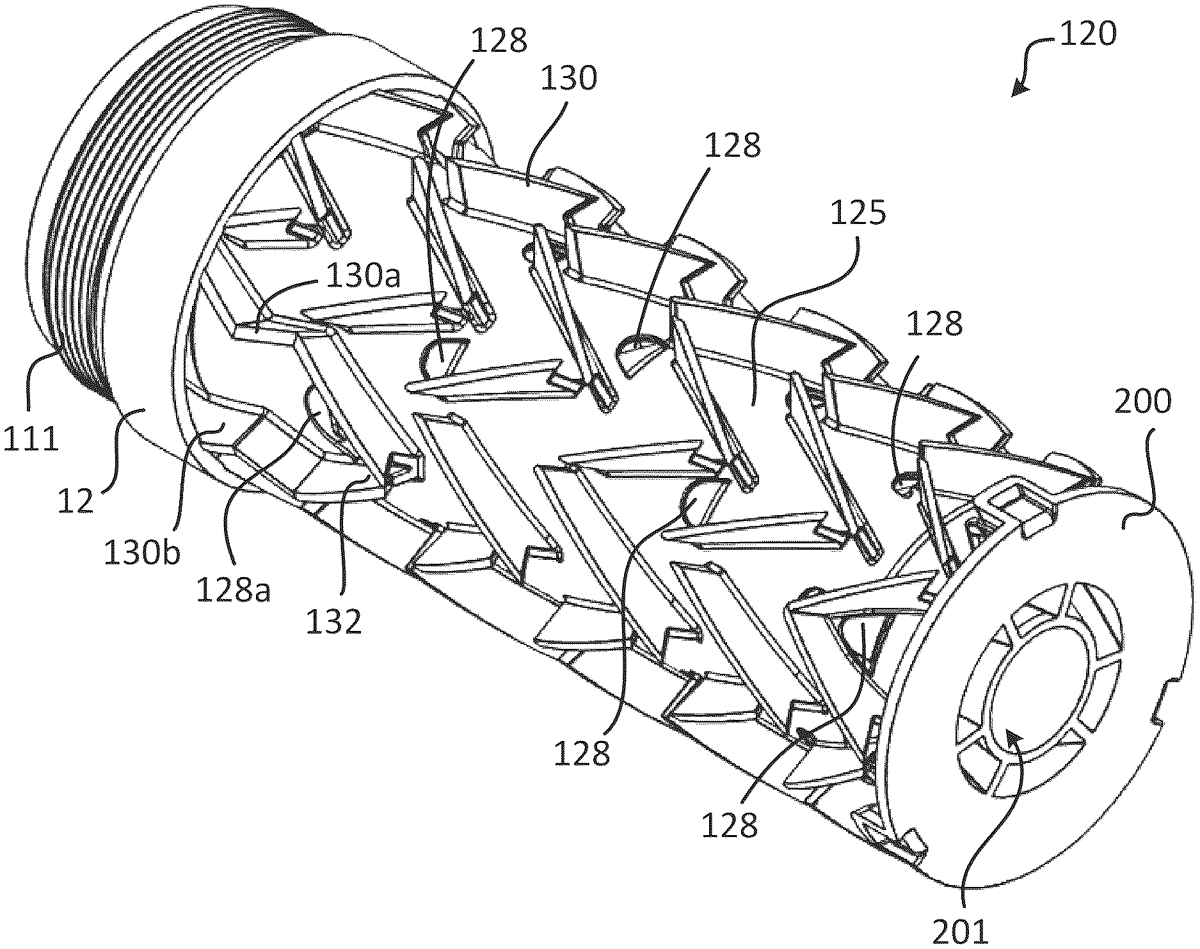
A suppressor for a firearm has a tubular housing extending along a bore axis from a proximal end to a distal end. A baffle stack within the hollow tubular housing extends along the bore axis and includes a tubular baffle wall with a plurality of baffle structures connected to an inside of the tubular baffle wall, where individual baffle structures taper proximally to a central opening on the bore axis. The suppressor defines an inner volume inside of the tubular baffle wall and an outer volume between the tubular baffle wall and the hollow tubular housing. Flow-directing structures in the outer volume include pairs of diverging vanes and pairs of converging vanes. A conduit between adjacent baffle structures defines a gas flow pathway in a radially outer portion of the inner volume and defines an opening located between the adjacent baffle structures to direct gas flow across the bore axis.