US12774877 - Method for aeronautical stabilization
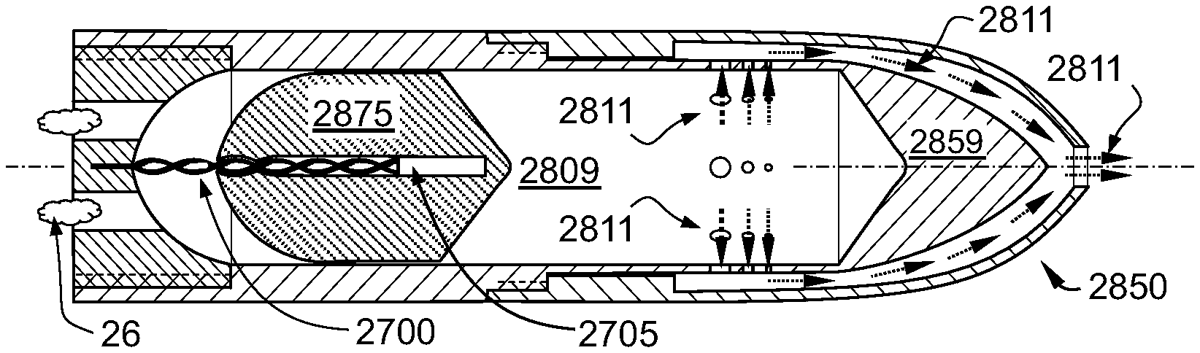
The patent describes a method for gyroscopically stabilizing a projectile during launch by utilizing a helical pair of members that translate and rotate in response to propulsive forces, thereby gaining angular momentum. This angular momentum allows the projectile to achieve stabilization as it advances towards its target after launch.
Claim 1
1 . A method for gyroscopically stabilizing a projectile, the method comprising: by the projectile during a projectile launch, experiencing propulsive force, wherein the projectile comprises a helical pair comprising two members; by the projectile during the projectile launch, responsive to experiencing the propulsive force, translating one of the two members along an axis of the projectile, wherein relative axial displacement between the two members occurs; by the projectile during the projectile launch, responsive to said translating one of the two members along the axis, synchronously rotating one of the two members about the axis, wherein relative rotation between the two members occurs; by the projectile during the projectile launch, gaining angular momentum from said synchronously rotating one of the two members about the axis; by the projectile, changing from said synchronously rotating one of the two members about the axis to producing free rotation between the two members about the axis; and by the projectile after the projectile launch, advancing towards a destination while said free rotation occurs, with the gained angular momentum gyroscopically stabilizing the projectile. by the projectile during a projectile launch, experiencing propulsive force, wherein the projectile comprises a helical pair comprising two members; by the projectile during the projectile launch, responsive to experiencing the propulsive force, translating one of the two members along an axis of the projectile, wherein relative axial displacement between the two members occurs; by the projectile during the projectile launch, responsive to said translating one of the two members along the axis, synchronously rotating one of the two members about the axis, wherein relative rotation between the two members occurs; by the projectile during the projectile launch, gaining angular momentum from said synchronously rotating one of the two members about the axis; by the projectile, changing from said synchronously rotating one of the two members about the axis to producing free rotation between the two members about the axis; and by the projectile after the projectile launch, advancing towards a destination while said free rotation occurs, with the gained angular momentum gyroscopically stabilizing the projectile.
Google Patents
https://patents.google.com/patent/US12774877
USPTO PDF
https://image-ppubs.uspto.gov/dirsearch-public/print/downloadPdf/12774877