US12754001 - Blasthole stemming based on formaldehyde resins, system and charging method
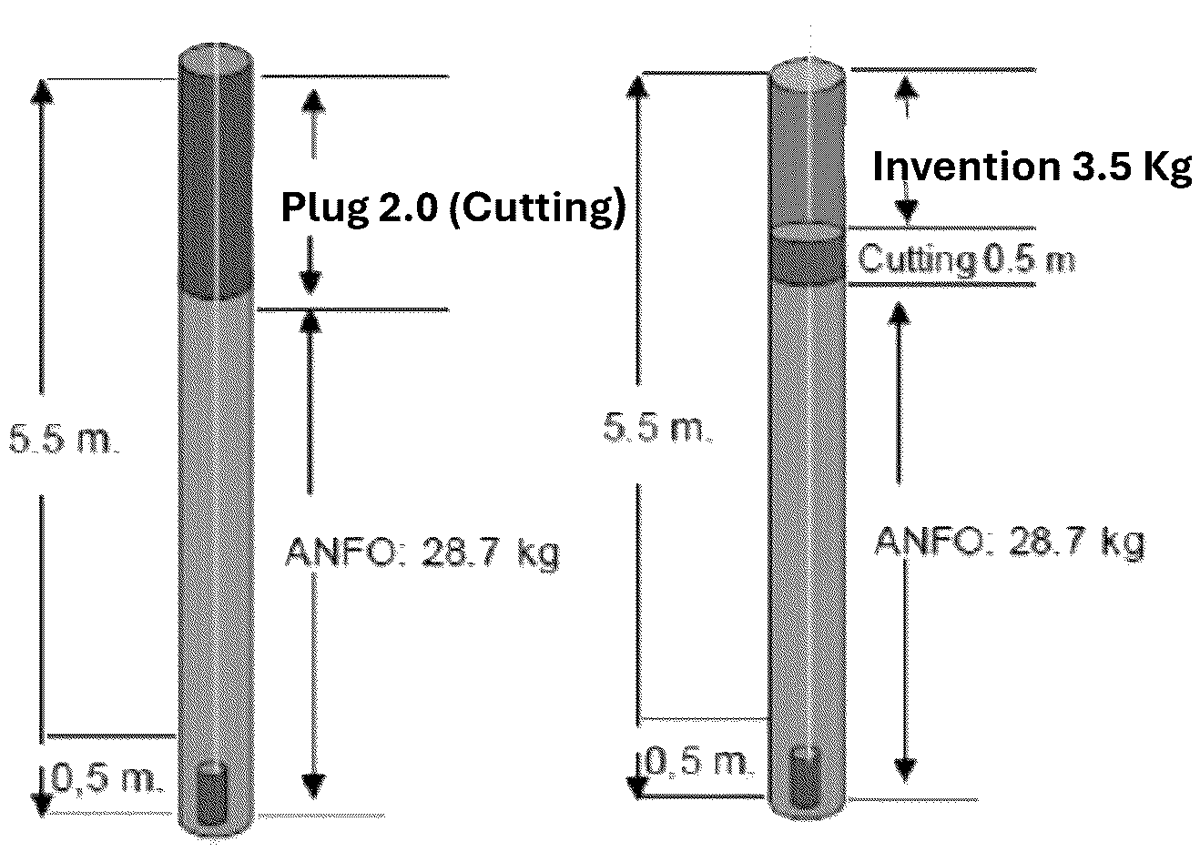
The patent describes a method for creating in situ mining blast hole plugs using a bi-component mixture of formaldehyde-based resin and catalyst, which forms a rigid foam upon setting. This foam is loaded into a blast hole above an explosive charge, and after hardening, it is detonated to facilitate mining operations.
Claim 1
1 . A method for forming in situ mining blast hole plugs comprising: loading a blast hole with a bi-component mixture of formaldehyde-based resin-catalyst on an explosive separated by a layer of drill cutting, where the loading order is as follows; first, the explosive is loaded at the bottom of the blast hole. then the layer of drill cutting is loaded in a minimum quantity that does not exceed 50 cm in height, and finally the bi-component mixture of formaldehyde-based resin-catalyst is loaded, where the bi-component mixture is produced in situ in the hole forming a foam, where the formaldehyde-based resin contained in a first pond is selected from phenol-formaldehyde (PF) resins, urea-formaldehyde (UF) resins, melamine-formaldehyde (MF) resins, melamine-urea-formaldehyde (MUF) resins, phenol-resorcinol-formaldehyde (PRF) resins, and modified formaldehyde-based resins with lignin or tannins; and the catalyst contained in a second pond is selected from acidic catalysts, basic catalysts, or based-en-cross-linking agent catalysts; allowing the foam to set, forming a rigid foam with a density between about 0.2 and about 0.3 Kg/m 3 and in which the reaction temperature is less than about 55° C., generating an expansion volume of about 3 to 5 times a loaded volume of the bi-component mixture; after the bi-component mixture has set, initiating detonation. loading a blast hole with a bi-component mixture of formaldehyde-based resin-catalyst on an explosive separated by a layer of drill cutting, where the loading order is as follows; first, the explosive is loaded at the bottom of the blast hole. then the layer of drill cutting is loaded in a minimum quantity that does not exceed 50 cm in height, and finally the bi-component mixture of formaldehyde-based resin-catalyst is loaded, where the bi-component mixture is produced in situ in the hole forming a foam, where the formaldehyde-based resin contained in a first pond is selected from phenol-formaldehyde (PF) resins, urea-formaldehyde (UF) resins, melamine-formaldehyde (MF) resins, melamine-urea-formaldehyde (MUF) resins, phenol-resorcinol-formaldehyde (PRF) resins, and modified formaldehyde-based resins with lignin or tannins; and the catalyst contained in a second pond is selected from acidic catalysts, basic catalysts, or based-en-cross-linking agent catalysts; allowing the foam to set, forming a rigid foam with a density between about 0.2 and about 0.3 Kg/m 3 and in which the reaction temperature is less than about 55° C., generating an expansion volume of about 3 to 5 times a loaded volume of the bi-component mixture; after the bi-component mixture has set, initiating detonation.
Google Patents
https://patents.google.com/patent/US12754001
USPTO PDF
https://image-ppubs.uspto.gov/dirsearch-public/print/downloadPdf/12754001