US12729930 - Handguard with barrel nut locking mechanisms
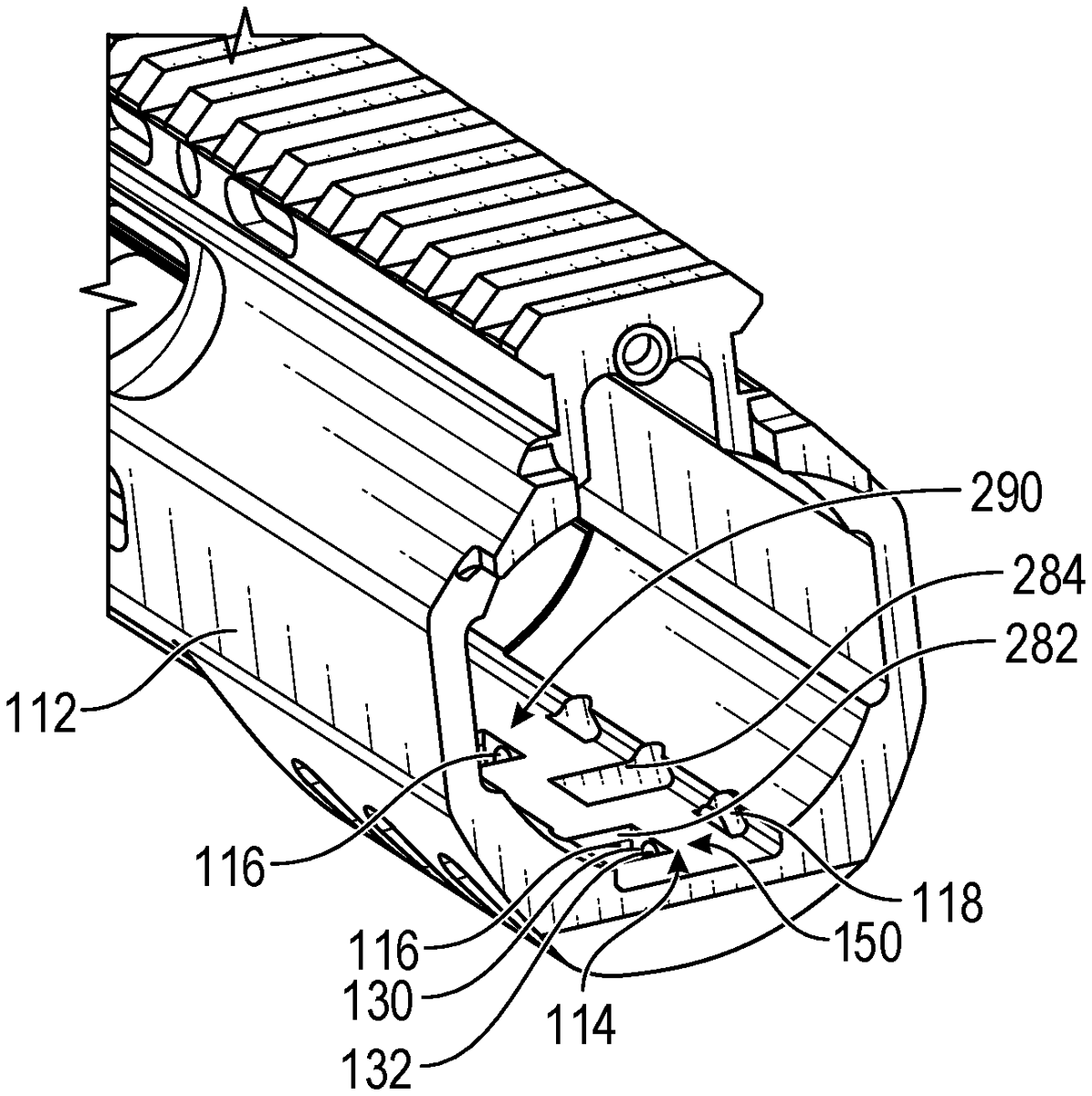
The patent describes a handguard system for firearms that incorporates a barrel nut and an adjustable locking mechanism utilizing multiple wedge members to secure the barrel. This system allows for incremental tightening at three distinct recessed rings on the barrel nut, enhancing stability and ease of adjustment.
Claim 1
1 . A handguard system of a firearm, the handguard system comprising: a barrel nut configured to secure a barrel to the firearm, the barrel nut comprising a radial profile that forms first, second and third recessed rings at spaced apart longitudinal positions of the barrel nut with respect to a proximate end of the handguard, wherein the first, second and third recessed rings each comprises respective sloping portions, the respective sloping portions comprising a longitudinal section of the barrel nut having a progressively decreasing diameter; a handguard comprising first, second and third pathways, the pathways being transversely disposed relative to the handguard and offset longitudinally along the handguard; and a first adjustable barrel nut locking mechanism disposed in the first pathway, a second adjustable barrel nut locking mechanism disposed in the second pathway, and a third adjustable barrel nut locking mechanism disposed in the third pathway, wherein: the first adjustable barrel nut locking mechanism comprising: a first wedge member, wherein the first wedge member has an asymmetrical outer profile that comprises a first flat wedge surface, a first curved wedge surface, and a first planar wedge adjustment surface at a first angle relative to the longitudinal axis of the first wedge member; a second wedge member; and a first biasing member configured to: couple the first wedge member to the second wedge member; and incrementally bias the first wedge member toward the second wedge member, which second wedge member is in a fixed position, upon actuation of the first biasing member, such that the first wedge member and the second wedge member tighten about the barrel nut at the first recessed ring, wherein first biasing member is positioned transversed to the longitudinal axis of the barrel nut, urging the first wedge member in a first direction; and the second adjustable barrel nut locking mechanism comprises: a third wedge member, wherein the third wedge member has an asymmetrical outer profile that comprises a second flat wedge surface, a second curved wedge surface, and a second planar wedge adjustment surface at the first angle relative to the longitudinal axis of the third wedge member; a fourth wedge member; and a second biasing member configured to: couple the third wedge member to the fourth wedge member; and incrementally bias the third wedge member toward the fourth wedge member, which fourth wedge member is in a fixed position, upon actuation of the second biasing member, such that the third wedge member and the fourth wedge member tighten about the barrel nut at the second recessed ring, wherein the second biasing member is positioned transverse to the longitudinal axis of the barrel nut, urging the third wedge member in a second direction, opposite the first direction; and the third adjustable barrel nut locking mechanism comprises: a fifth wedge member, wherein the fifth wedge member has an asymmetrical outer profile that comprises a third flat wedge surface, a third curved wedge surface, and a third planar wedge adjustment surface at the first angle relative to the longitudinal axis of the fifth wedge member; a sixth wedge member; and a third biasing member configured to: couple the fifth wedge member to the sixth wedge member; and incrementally bias the fifth wedge member toward the sixth wedge member, which is in a fixed position, upon actuation of the third biasing member, such that the fifth wedge member and the sixth wedge member tighten about the barrel nut at the third at the third recessed ring, wherein the third biasing member is positioned transverse to the longitudinal axis of the barrel nut, urging the fifth wedge member in the first direction. a barrel nut configured to secure a barrel to the firearm, the barrel nut comprising a radial profile that forms first, second and third recessed rings at spaced apart longitudinal positions of the barrel nut with respect to a proximate end of the handguard, wherein the first, second and third recessed rings each comprises respective sloping portions, the respective sloping portions comprising a longitudinal section of the barrel nut having a progressively decreasing diameter; a handguard comprising first, second and third pathways, the pathways being transversely disposed relative to the handguard and offset longitudinally along the handguard; and a first adjustable barrel nut locking mechanism disposed in the first pathway, a second adjustable barrel nut locking mechanism disposed in the second pathway, and a third adjustable barrel nut locking mechanism disposed in the third pathway, wherein: the first adjustable barrel nut locking mechanism comprising: a first wedge member, wherein the first wedge member has an asymmetrical outer profile that comprises a first flat wedge surface, a first curved wedge surface, and a first planar wedge adjustment surface at a first angle relative to the longitudinal axis of the first wedge member; a second wedge member; and a first biasing member configured to: couple the first wedge member to the second wedge member; and incrementally bias the first wedge member toward the second wedge member, which second wedge member is in a fixed position, upon actuation of the first biasing member, such that the first wedge member and the second wedge member tighten about the barrel nut at the first recessed ring, wherein first biasing member is positioned transversed to the longitudinal axis of the barrel nut, urging the first wedge member in a first direction; and a first wedge member, wherein the first wedge member has an asymmetrical outer profile that comprises a first flat wedge surface, a first curved wedge surface, and a first planar wedge adjustment surface at a first angle relative to the longitudinal axis of the first wedge member; a second wedge member; and a first biasing member configured to: couple the first wedge member to the second wedge member; and incrementally bias the first wedge member toward the second wedge member, which second wedge member is in a fixed position, upon actuation of the first biasing member, such that the first wedge member and the second wedge member tighten about the barrel nut at the first recessed ring, couple the first wedge member to the second wedge member; and incrementally bias the first wedge member toward the second wedge member, which second wedge member is in a fixed position, upon actuation of the first biasing member, such that the first wedge member and the second wedge member tighten about the barrel nut at the first recessed ring, wherein first biasing member is positioned transversed to the longitudinal axis of the barrel nut, urging the first wedge member in a first direction; and the second adjustable barrel nut locking mechanism comprises: a third wedge member, wherein the third wedge member has an asymmetrical outer profile that comprises a second flat wedge surface, a second curved wedge surface, and a second planar wedge adjustment surface at the first angle relative to the longitudinal axis of the third wedge member; a fourth wedge member; and a second biasing member configured to: couple the third wedge member to the fourth wedge member; and incrementally bias the third wedge member toward the fourth wedge member, which fourth wedge member is in a fixed position, upon actuation of the second biasing member, such that the third wedge member and the fourth wedge member tighten about the barrel nut at the second recessed ring, wherein the second biasing member is positioned transverse to the longitudinal axis of the barrel nut, urging the third wedge member in a second direction, opposite the first direction; and a third wedge member, wherein the third wedge member has an asymmetrical outer profile that comprises a second flat wedge surface, a second curved wedge surface, and a second planar wedge adjustment surface at the first angle relative to the longitudinal axis of the third wedge member; a fourth wedge member; and a second biasing member configured to: couple the third wedge member to the fourth wedge member; and incrementally bias the third wedge member toward the fourth wedge member, which fourth wedge member is in a fixed position, upon actuation of the second biasing member, such that the third wedge member and the fourth wedge member tighten about the barrel nut at the second recessed ring, couple the third wedge member to the fourth wedge member; and incrementally bias the third wedge member toward the fourth wedge member, which fourth wedge member is in a fixed position, upon actuation of the second biasing member, such that the third wedge member and the fourth wedge member tighten about the barrel nut at the second recessed ring, wherein the second biasing member is positioned transverse to the longitudinal axis of the barrel nut, urging the third wedge member in a second direction, opposite the first direction; and the third adjustable barrel nut locking mechanism comprises: a fifth wedge member, wherein the fifth wedge member has an asymmetrical outer profile that comprises a third flat wedge surface, a third curved wedge surface, and a third planar wedge adjustment surface at the first angle relative to the longitudinal axis of the fifth wedge member; a sixth wedge member; and a third biasing member configured to: couple the fifth wedge member to the sixth wedge member; and incrementally bias the fifth wedge member toward the sixth wedge member, which is in a fixed position, upon actuation of the third biasing member, such that the fifth wedge member and the sixth wedge member tighten about the barrel nut at the third at the third recessed ring, wherein the third biasing member is positioned transverse to the longitudinal axis of the barrel nut, urging the fifth wedge member in the first direction. a fifth wedge member, wherein the fifth wedge member has an asymmetrical outer profile that comprises a third flat wedge surface, a third curved wedge surface, and a third planar wedge adjustment surface at the first angle relative to the longitudinal axis of the fifth wedge member; a sixth wedge member; and a third biasing member configured to: couple the fifth wedge member to the sixth wedge member; and incrementally bias the fifth wedge member toward the sixth wedge member, which is in a fixed position, upon actuation of the third biasing member, such that the fifth wedge member and the sixth wedge member tighten about the barrel nut at the third at the third recessed ring, couple the fifth wedge member to the sixth wedge member; and incrementally bias the fifth wedge member toward the sixth wedge member, which is in a fixed position, upon actuation of the third biasing member, such that the fifth wedge member and the sixth wedge member tighten about the barrel nut at the third at the third recessed ring, wherein the third biasing member is positioned transverse to the longitudinal axis of the barrel nut, urging the fifth wedge member in the first direction.
Google Patents
https://patents.google.com/patent/US12729930
USPTO PDF
https://image-ppubs.uspto.gov/dirsearch-public/print/downloadPdf/12729930