US12716684 - Slider mechanism for collapsible firearm stock
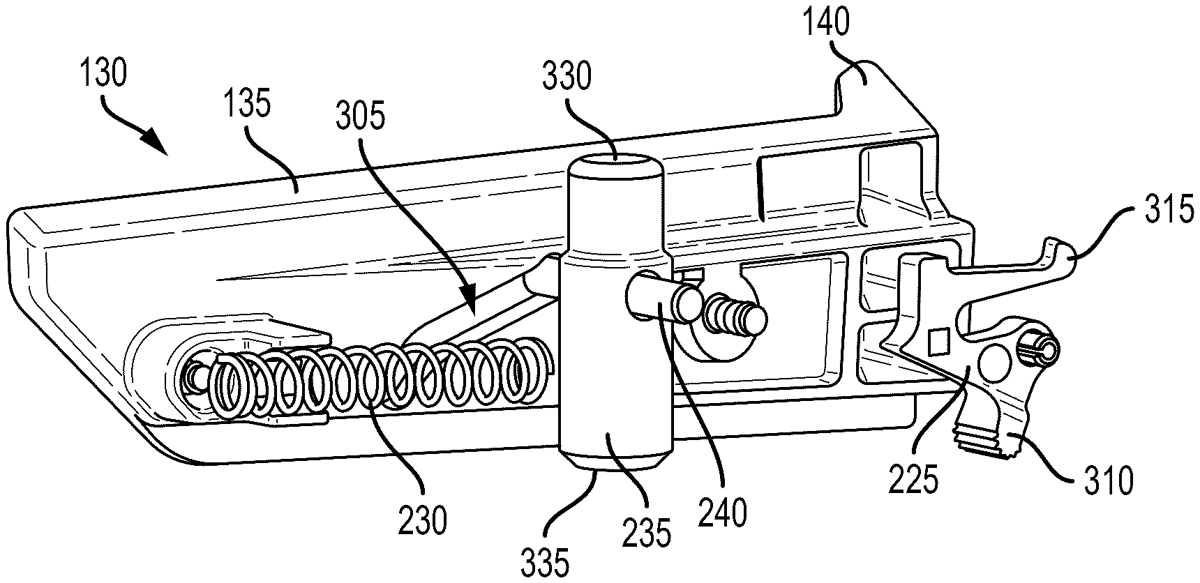
The patent describes a collapsible firearm stock featuring a slider mechanism that includes a biasing mechanism, lock pin, and release pin to facilitate the adjustment of the stock’s length. This design allows for smooth movement of the slider panels along a defined track, enhancing user adaptability and comfort.
Claim 1
1 . A buttstock comprising: a proximal end configured to contact a user object and a distal end configured to slidably couple with a receiver extension, wherein an internal cavity of the buttstock is defined between the proximal end and the distal end; a first slider panel defining a channel; a second slider panel coupled with the first slider panel by a fastener extending through the internal cavity of the buttstock, wherein the first slider panel and the second slider panel are configured to travel along a horizontal track defined by a body of the buttstock; a biasing mechanism disposed in the internal cavity, the biasing mechanism configured to bias the first slider panel toward the distal end of the buttstock; a lock pin disposed in the internal cavity and configured to contact the biasing mechanism, wherein a longitudinal axis of the lock pin is substantially orthogonal to a longitudinal axis of the biasing mechanism; and a release pin extending through the lock pin, wherein a longitudinal axis of the release pin is substantially orthogonal to the longitudinal axis of the lock pin and substantially orthogonal to the longitudinal axis of the biasing mechanism; wherein: an end portion of the release pin extends into the channel; the release pin is configured to travel along a path defined by the channel in response to a movement of the first slider panel; and the release pin is configured to cause the lock pin to transition from a first position to a second position in response to the movement. a proximal end configured to contact a user object and a distal end configured to slidably couple with a receiver extension, wherein an internal cavity of the buttstock is defined between the proximal end and the distal end; a first slider panel defining a channel; a second slider panel coupled with the first slider panel by a fastener extending through the internal cavity of the buttstock, wherein the first slider panel and the second slider panel are configured to travel along a horizontal track defined by a body of the buttstock; a biasing mechanism disposed in the internal cavity, the biasing mechanism configured to bias the first slider panel toward the distal end of the buttstock; a lock pin disposed in the internal cavity and configured to contact the biasing mechanism, wherein a longitudinal axis of the lock pin is substantially orthogonal to a longitudinal axis of the biasing mechanism; and a release pin extending through the lock pin, wherein a longitudinal axis of the release pin is substantially orthogonal to the longitudinal axis of the lock pin and substantially orthogonal to the longitudinal axis of the biasing mechanism; wherein: an end portion of the release pin extends into the channel; the release pin is configured to travel along a path defined by the channel in response to a movement of the first slider panel; and the release pin is configured to cause the lock pin to transition from a first position to a second position in response to the movement. an end portion of the release pin extends into the channel; the release pin is configured to travel along a path defined by the channel in response to a movement of the first slider panel; and the release pin is configured to cause the lock pin to transition from a first position to a second position in response to the movement.
Google Patents
https://patents.google.com/patent/US12716684
USPTO PDF
https://image-ppubs.uspto.gov/dirsearch-public/print/downloadPdf/12716684