US12716675 - Firearm training system and method utilizing distributed stimulus projection
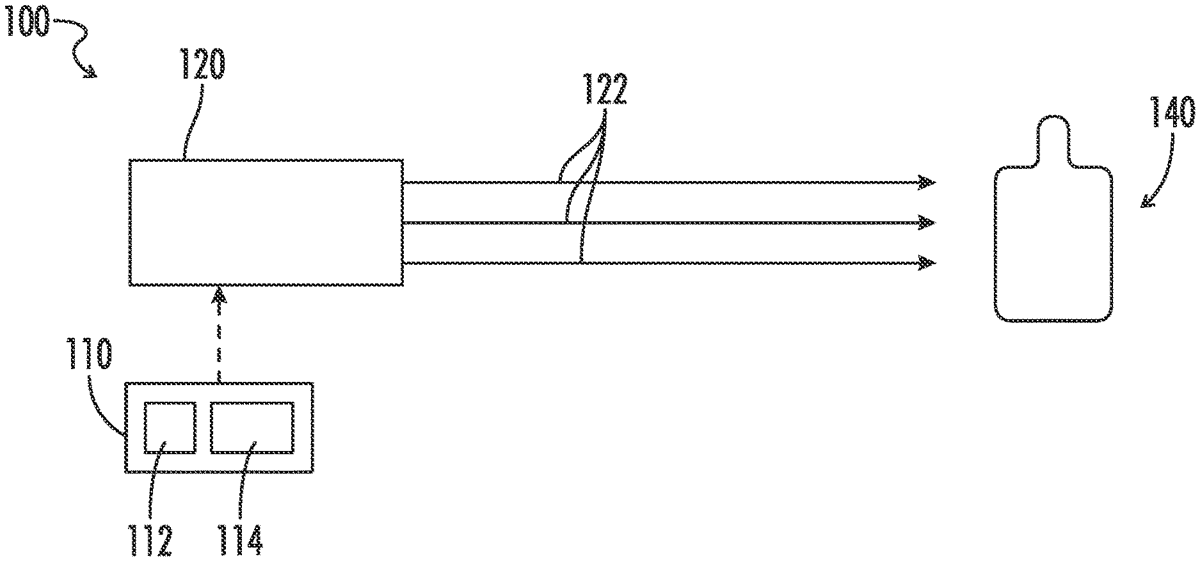
The patent describes a firearm training system that utilizes portable devices to project dynamic visual stimuli onto external targets, enhancing training efficiency and effectiveness. These devices incorporate laser sources, audio outputs, and sensors to assess user performance and adapt the training scenario in real-time based on the user’s actions.
Claim 1
1 . A firearm training system for selectively generating images onto external target elements, comprising: one or more portable devices selectively mounted with respect to selected ones of the external target elements, each comprising: a housing accommodating and configured for optical projection of light from one or more laser sources and one or more diffractive optical elements configured to generate one or more shape outlines via the optical projection of light; one or more audio outputs; one or more sensors each having a microphone and an accelerometer communicatively linked to at least one controller; and the at least one controller configured to: determine a dynamic target stimulus arrangement for a given training environment, direct a projection of light from one or more of the one or more laser sources, and generation of audible signals from the one or more audio outputs, according to the determined dynamic target stimulus arrangement, determine user performance at least partially by correlating the generated audible signals and optically projected light according to the dynamic target stimulus arrangement with inputs corresponding to physical actions of the user; compare determined user performance with one or more target parameters associated with user performance; and based on the determined user performance as compared with the one or more target parameters associated therewith, dynamically modify at least one of a location, sequence, or assigned difficulty level associated with the target stimulus arrangement, wherein dynamically modifying the target stimulus arrangement comprises selectively causing one or more of the shape outlines generated via the one or more diffractive optical elements to appear, disappear, or change based on the comparison. one or more portable devices selectively mounted with respect to selected ones of the external target elements, each comprising: a housing accommodating and configured for optical projection of light from one or more laser sources and one or more diffractive optical elements configured to generate one or more shape outlines via the optical projection of light; one or more audio outputs; one or more sensors each having a microphone and an accelerometer communicatively linked to at least one controller; and the at least one controller configured to: determine a dynamic target stimulus arrangement for a given training environment, direct a projection of light from one or more of the one or more laser sources, and generation of audible signals from the one or more audio outputs, according to the determined dynamic target stimulus arrangement, determine user performance at least partially by correlating the generated audible signals and optically projected light according to the dynamic target stimulus arrangement with inputs corresponding to physical actions of the user; compare determined user performance with one or more target parameters associated with user performance; and based on the determined user performance as compared with the one or more target parameters associated therewith, dynamically modify at least one of a location, sequence, or assigned difficulty level associated with the target stimulus arrangement, wherein dynamically modifying the target stimulus arrangement comprises selectively causing one or more of the shape outlines generated via the one or more diffractive optical elements to appear, disappear, or change based on the comparison. a housing accommodating and configured for optical projection of light from one or more laser sources and one or more diffractive optical elements configured to generate one or more shape outlines via the optical projection of light; one or more audio outputs; one or more sensors each having a microphone and an accelerometer communicatively linked to at least one controller; and the at least one controller configured to: determine a dynamic target stimulus arrangement for a given training environment, direct a projection of light from one or more of the one or more laser sources, and generation of audible signals from the one or more audio outputs, according to the determined dynamic target stimulus arrangement, determine user performance at least partially by correlating the generated audible signals and optically projected light according to the dynamic target stimulus arrangement with inputs corresponding to physical actions of the user; compare determined user performance with one or more target parameters associated with user performance; and based on the determined user performance as compared with the one or more target parameters associated therewith, dynamically modify at least one of a location, sequence, or assigned difficulty level associated with the target stimulus arrangement, wherein dynamically modifying the target stimulus arrangement comprises selectively causing one or more of the shape outlines generated via the one or more diffractive optical elements to appear, disappear, or change based on the comparison. determine a dynamic target stimulus arrangement for a given training environment, direct a projection of light from one or more of the one or more laser sources, and generation of audible signals from the one or more audio outputs, according to the determined dynamic target stimulus arrangement, determine user performance at least partially by correlating the generated audible signals and optically projected light according to the dynamic target stimulus arrangement with inputs corresponding to physical actions of the user; compare determined user performance with one or more target parameters associated with user performance; and based on the determined user performance as compared with the one or more target parameters associated therewith, dynamically modify at least one of a location, sequence, or assigned difficulty level associated with the target stimulus arrangement, wherein dynamically modifying the target stimulus arrangement comprises selectively causing one or more of the shape outlines generated via the one or more diffractive optical elements to appear, disappear, or change based on the comparison.
Google Patents
https://patents.google.com/patent/US12716675
USPTO PDF
https://image-ppubs.uspto.gov/dirsearch-public/print/downloadPdf/12716675