US12693516 - Aperture extender for autocollimators and telescopes having index-matching gel or fluid between prism facets
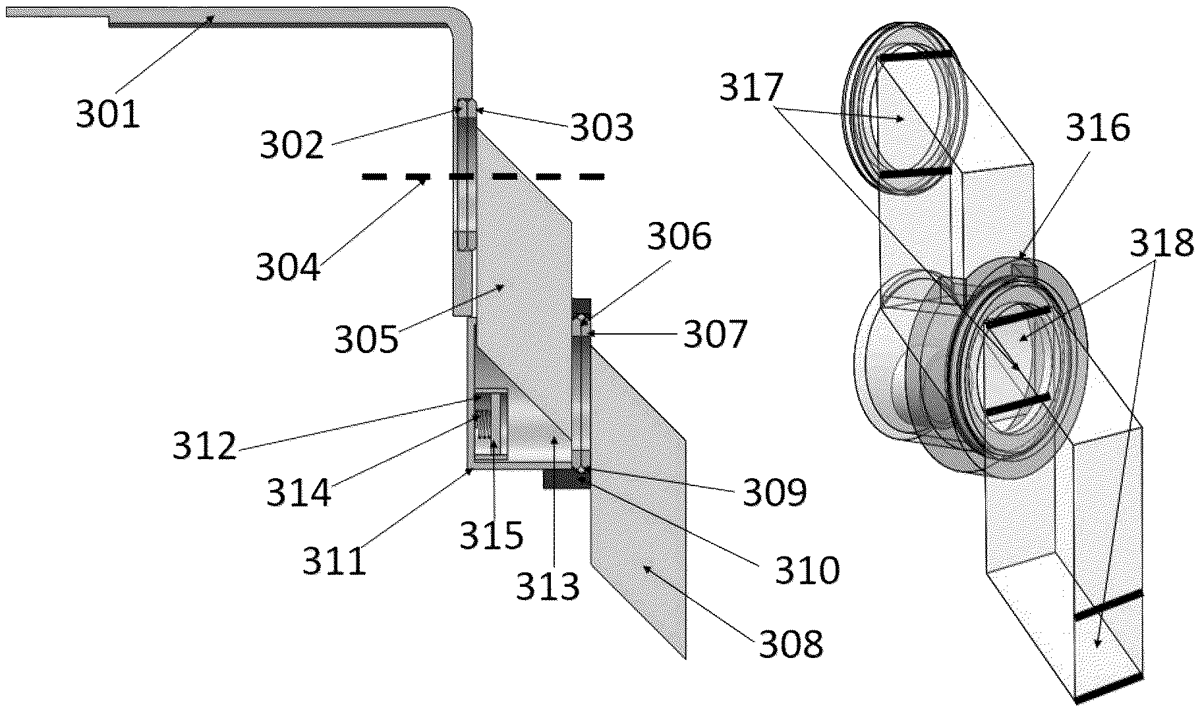
The patent describes an aperture extender system for optical devices that utilizes two interconnected rhomboidal prisms, allowing for enhanced precision in autocollimators by correcting line-of-sight deviations. The system features a microprocessor that processes diagnostic images and adjusts for manufacturing imperfections, effectively widening the autocollimator’s aperture.
Claim 1
1 . An aperture extender system for optical devices, comprising a first rhomboidal prism and a second rhomboidal prism interconnected in series; a first rotating coupling securing the first rhomboidal prism to an autocollimator’s aperture such that the first rhomboidal prism rotates concentrically about the autocollimator’s optical axis; a second rotating coupling securing the second rhomboidal prism to an exit facet of the first rhomboidal prism such that the second rhomboidal prism rotates about the optical axis of an exiting beam; wherein a sealed cavity is formed between adjacent facets of the rhomboidal prisms and contains an index-matching gel or fluid that eliminates inter-reflections during rotation; wherein each rhomboidal prism includes a partial-mirror coating configured to generate wavelength-selective back-reflected diagnostic images; and wherein a microprocessor receives the back-reflected diagnostic images and computes correction data for line-of-sight deviations introduced by prism manufacturing or alignment imperfections, such that the interconnected rotating rhomboidal prisms widen the effective aperture of the autocollimator beyond its original physical limits. a second rotating coupling securing the second rhomboidal prism to an exit facet of the first rhomboidal prism such that the second rhomboidal prism rotates about the optical axis of an exiting beam; wherein a sealed cavity is formed between adjacent facets of the rhomboidal prisms and contains an index-matching gel or fluid that eliminates inter-reflections during rotation; wherein each rhomboidal prism includes a partial-mirror coating configured to generate wavelength-selective back-reflected diagnostic images; and wherein a microprocessor receives the back-reflected diagnostic images and computes correction data for line-of-sight deviations introduced by prism manufacturing or alignment imperfections, such that the interconnected rotating rhomboidal prisms widen the effective aperture of the autocollimator beyond its original physical limits.
Google Patents
https://patents.google.com/patent/US12693516
USPTO PDF
https://image-ppubs.uspto.gov/dirsearch-public/print/downloadPdf/12693516