US12662301 - Pepper spray dispensing systems and devices and methods of use
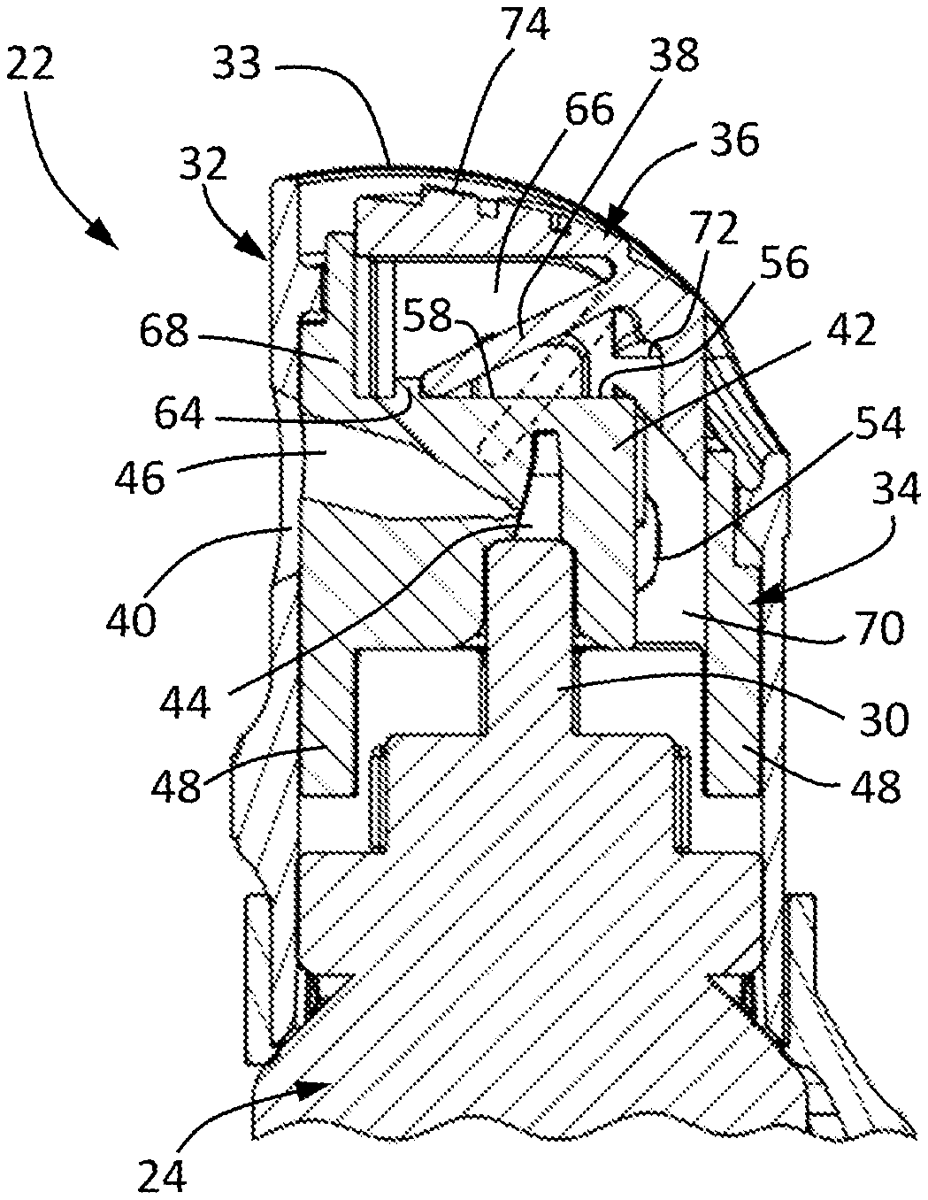
The patent describes a pepper spray dispenser that features a cap, a translatable nozzle, and an actuator, all designed to work with a pressurized canister of pepper spray. It includes a biasing member that creates a force to separate the actuator and nozzle, allowing for a two-stage actuation process to dispense the spray effectively.
Claim 1
1 . A pepper spray dispenser comprising: a cap configured to attach to a canister that contains a pressurized pepper spray; a nozzle disposed within the cap so as to be translatable relative to the cap, the nozzle being configured to attach to a valve stem of the canister, the nozzle comprising a passageway through which the pressurized pepper spray is able to pass from the container and be dispersed by the nozzle; an actuator disposed in the cap so as to be translatable relative to the cap and relative to the nozzle; a biasing member operatively interposed between the actuator and the nozzle and generating a biasing force that urges the actuator and the nozzle apart from each other and urges the actuator toward an unactuated position of the pepper spray dispenser; wherein the pepper spray dispenser has a partially actuated position and a fully actuated position, the partially actuated position follows a first actuation stage resulting from the actuator being translated toward the valve stem of the canister until the actuator abuts the nozzle without causing the nozzle to translate and therefore without causing the valve stem to translate, and the fully actuated position follows a second actuation stage resulting from the actuator being further translated toward the valve stem to cause the nozzle to simultaneously translate with the actuator and therefore also cause the valve stem to translate and release the pressurized pepper spray through the passageway within the nozzle; wherein the biasing force generated by the biasing member increases during the first actuation stage and does not increase during the second actuation stage; wherein during the first actuation stage a distal end of the biasing member slides along a bearing surface of the nozzle; and wherein the bearing surface comprises a detent that the biasing member surmounts during the first actuation stage, the detent causing an abrupt but transitory increase in the biasing force during the first actuation stage. a cap configured to attach to a canister that contains a pressurized pepper spray; a nozzle disposed within the cap so as to be translatable relative to the cap, the nozzle being configured to attach to a valve stem of the canister, the nozzle comprising a passageway through which the pressurized pepper spray is able to pass from the container and be dispersed by the nozzle; an actuator disposed in the cap so as to be translatable relative to the cap and relative to the nozzle; a biasing member operatively interposed between the actuator and the nozzle and generating a biasing force that urges the actuator and the nozzle apart from each other and urges the actuator toward an unactuated position of the pepper spray dispenser; wherein the pepper spray dispenser has a partially actuated position and a fully actuated position, the partially actuated position follows a first actuation stage resulting from the actuator being translated toward the valve stem of the canister until the actuator abuts the nozzle without causing the nozzle to translate and therefore without causing the valve stem to translate, and the fully actuated position follows a second actuation stage resulting from the actuator being further translated toward the valve stem to cause the nozzle to simultaneously translate with the actuator and therefore also cause the valve stem to translate and release the pressurized pepper spray through the passageway within the nozzle; wherein the biasing force generated by the biasing member increases during the first actuation stage and does not increase during the second actuation stage; wherein during the first actuation stage a distal end of the biasing member slides along a bearing surface of the nozzle; and wherein the bearing surface comprises a detent that the biasing member surmounts during the first actuation stage, the detent causing an abrupt but transitory increase in the biasing force during the first actuation stage.
Google Patents
https://patents.google.com/patent/US12662301
USPTO PDF
https://image-ppubs.uspto.gov/dirsearch-public/print/downloadPdf/12662301