US12638564 - Wavefront correction for aerodynamic and atmospheric effects to an optical sensor on a high-speed flight vehicle
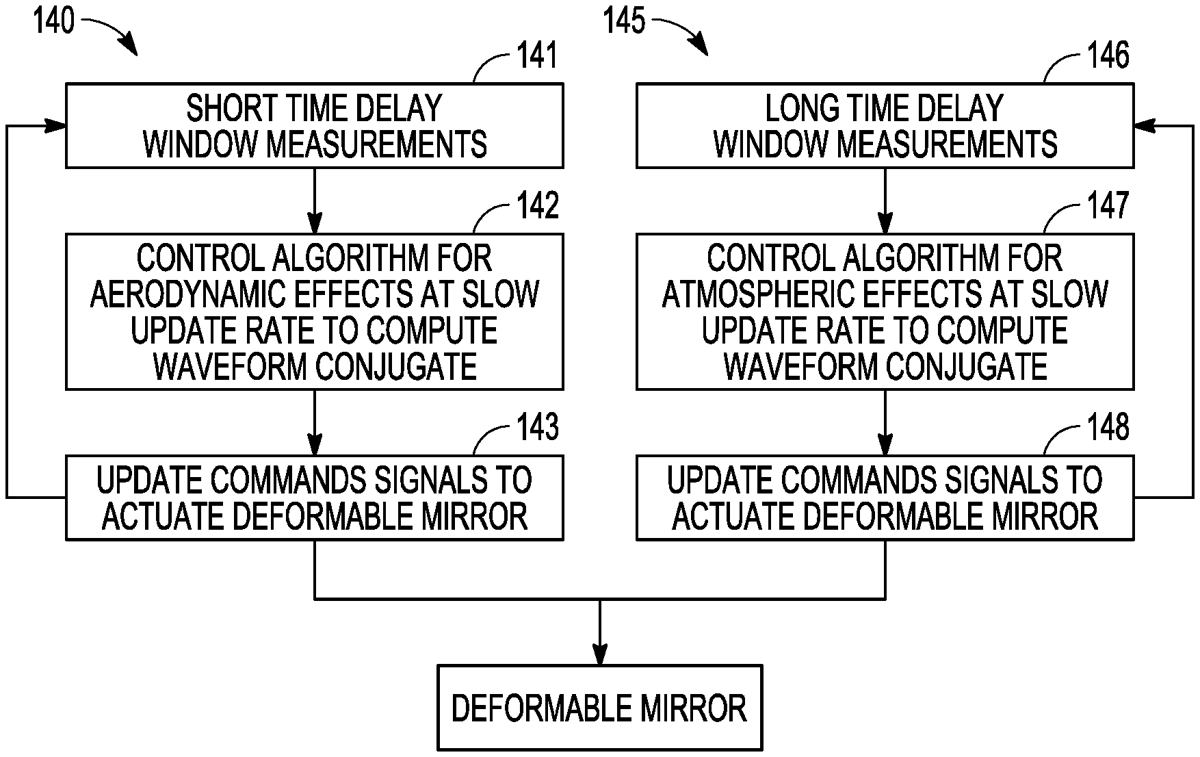
The patent describes an optical sensor system for supersonic flight vehicles that corrects for aero-optical and aero-thermal effects on the sensor’s window using a deformable mirror and a pulsed laser. This system enhances target detection capabilities by actively illuminating targets while measuring and compensating for distortions caused by environmental factors.
Claim 1
1 . An optical sensor for a supersonic flight vehicle in which an optical window to the sensor undergoes aero-optical and aero-thermal effects in flight, said optical-sensor comprising: a clock; a pulsed laser that emits laser pulses through the optical window with timing codes referenced to the clock; a wavefront sensor referenced to the clock to detect returning laser pulses that lie within a first time delay window to measure the aero-optical and aero-thermal effects on or just in front of the optical window and to exclude atmospheric effects beyond the optical window, wherein aero-optical effects are caused by fluctuations of a refractive index of the optical window due to temperature and pressure differences around the optical window and aero-thermal effects are caused by heating of the optical window; an optical detector; an optical path that couples light received through the optical window onto the optical detector; and a deformable mirror positioned in the optical path, said deformable mirror responsive to command signals to piston orthogonal to the plane of the mirror to correct a wavefront of the received light for the measured aero-optical and aero-thermal effects. a clock; a pulsed laser that emits laser pulses through the optical window with timing codes referenced to the clock; a wavefront sensor referenced to the clock to detect returning laser pulses that lie within a first time delay window to measure the aero-optical and aero-thermal effects on or just in front of the optical window and to exclude atmospheric effects beyond the optical window, wherein aero-optical effects are caused by fluctuations of a refractive index of the optical window due to temperature and pressure differences around the optical window and aero-thermal effects are caused by heating of the optical window; an optical detector; an optical path that couples light received through the optical window onto the optical detector; and a deformable mirror positioned in the optical path, said deformable mirror responsive to command signals to piston orthogonal to the plane of the mirror to correct a wavefront of the received light for the measured aero-optical and aero-thermal effects.
Google Patents
https://patents.google.com/patent/US12638564
USPTO PDF
https://image-ppubs.uspto.gov/dirsearch-public/print/downloadPdf/12638564