US12613330 - Systems and methods for using a conducted energy weapon in conjunction with a noninvasive detection of impermissible objects
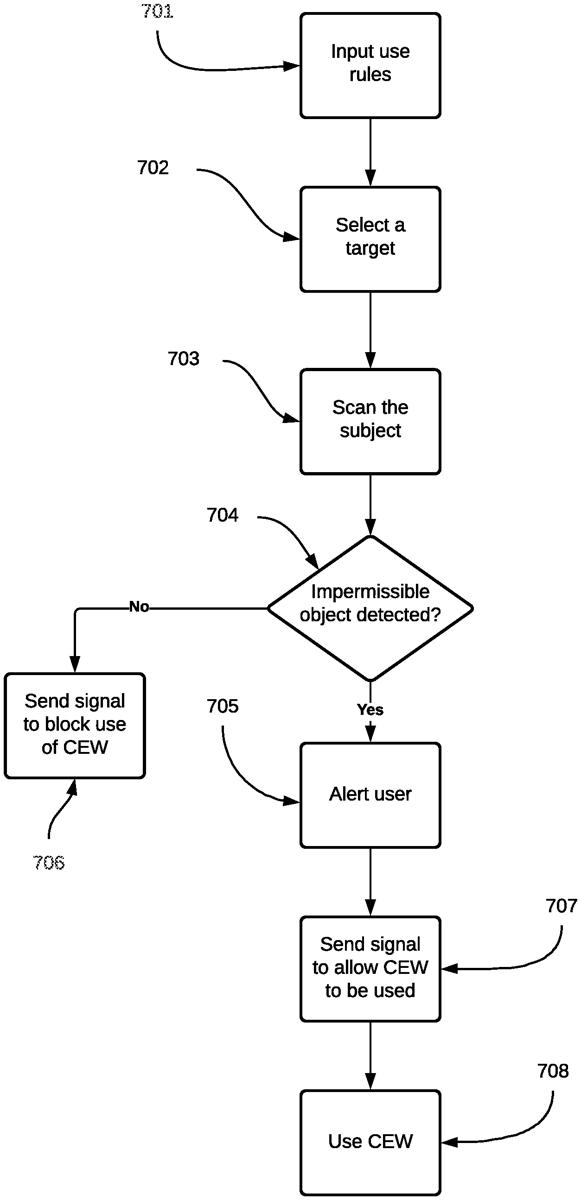
The patent describes a system that integrates a conducted energy weapon with a portable radar system capable of detecting concealed objects on a person. This system allows a user to fire the weapon at a subject determined to have an impermissible object based on radar scan results.
Claim 1
1 . A method comprising: scanning a subject with a portable coherent radar system on a single chip that operates in a range of operation between approximately 0.1 terahertz and 1 terahertz, the portable coherent radar system being in communication with a conducted energy weapon, the conducted energy weapon configured to allow a user to fire at least one electrode when an impermissible object is determined to be present on the subject; determining by a processor, based on the results of the scan, if the impermissible object is present on the subject; sending, by the processor, a signal to allow the user to fire the at least one electrode from the conducted energy weapon when the impermissible object is determined to be present on the subject; firing, by the user, the at least one electrode at the subject, where the portable coherent radar system includes: a transmitter having at least a ramp generator electrically coupled to, and configured to provide a voltage signal to, a wide band voltage controlled oscillator, a directional coupler electrically coupled to the wide band voltage controlled oscillator, and a phased-array antenna electrically coupled to the directional coupler and configured to transmit high-frequency signals in the range of operation. scanning a subject with a portable coherent radar system on a single chip that operates in a range of operation between approximately 0.1 terahertz and 1 terahertz, the portable coherent radar system being in communication with a conducted energy weapon, the conducted energy weapon configured to allow a user to fire at least one electrode when an impermissible object is determined to be present on the subject; determining by a processor, based on the results of the scan, if the impermissible object is present on the subject; sending, by the processor, a signal to allow the user to fire the at least one electrode from the conducted energy weapon when the impermissible object is determined to be present on the subject; firing, by the user, the at least one electrode at the subject, scanning a subject with a portable coherent radar system on a single chip that operates in a range of operation between approximately 0.1 terahertz and 1 terahertz, the portable coherent radar system being in communication with a conducted energy weapon, the conducted energy weapon configured to allow a user to fire at least one electrode when an impermissible object is determined to be present on the subject; determining by a processor, based on the results of the scan, if the impermissible object is present on the subject; sending, by the processor, a signal to allow the user to fire the at least one electrode from the conducted energy weapon when the impermissible object is determined to be present on the subject; firing, by the user, the at least one electrode at the subject, where the portable coherent radar system includes: a transmitter having at least a ramp generator electrically coupled to, and configured to provide a voltage signal to, a wide band voltage controlled oscillator, a directional coupler electrically coupled to the wide band voltage controlled oscillator, and a phased-array antenna electrically coupled to the directional coupler and configured to transmit high-frequency signals in the range of operation. a transmitter having at least a ramp generator electrically coupled to, and configured to provide a voltage signal to, a wide band voltage controlled oscillator, a directional coupler electrically coupled to the wide band voltage controlled oscillator, and a phased-array antenna electrically coupled to the directional coupler and configured to transmit high-frequency signals in the range of operation.
Google Patents
https://patents.google.com/patent/US12613330
USPTO PDF
https://image-ppubs.uspto.gov/dirsearch-public/print/downloadPdf/12613330