US12613084 - Inertial delay mechanisms for low-G and long-duration acceleration event detection and for initiation devices in munitions and impulse switches and the like
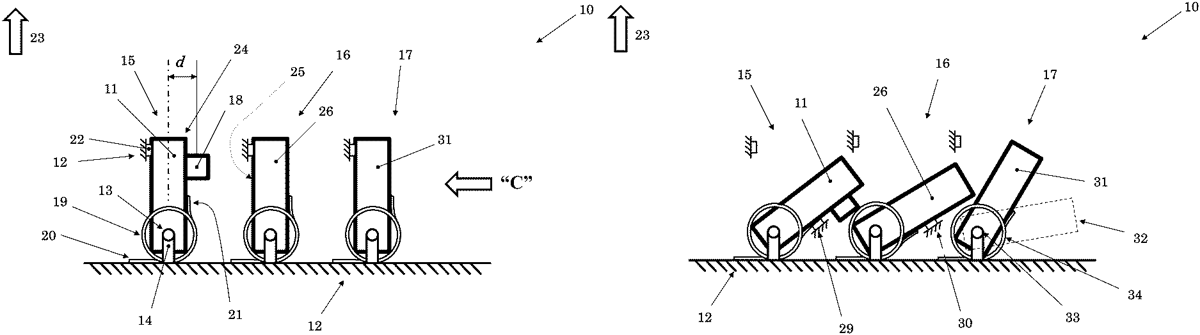
The patent describes an inertial mechanical delay mechanism designed to detect low-G and long-duration acceleration events, utilizing two rotary assemblies that interact based on acceleration thresholds. It includes a blocking mechanism to prevent activation when acceleration exceeds a specified magnitude, enhancing safety in munitions and impulse switches.
Claim 1
1 . An inertial mechanical delay mechanism comprising: a first rotary assembly comprising: a first rotary member configured to be rotatable about a first rotary axis in a first rotation direction relative to a base, the first rotary member having a first center of mass offset from a line parallel to a direction of acceleration of the base and perpendicular from the first rotary axis of the first rotary member; and a first elastic material configured to exert a first biasing force to the first rotary member to bias the first rotary member in a second rotation direction opposite to the first rotation direction; and a second rotary assembly comprising: a second rotary member configured to be rotatable about a second rotary axis in a third rotation direction relative to the base, the second rotary member being rotatable in the third rotation direction by at least indirect interaction with the first rotary member when the first rotary member rotates a first predetermined angle in the first rotation direction; a second elastic material configured to exert a second biasing force to the second rotary member to bias the second rotary member in a fourth rotation direction opposite to the third rotation direction; wherein the first rotary assembly is configured to rotate the first predetermined angle when the acceleration is greater than a predetermined magnitude and duration; and an activation prevention mechanism having a blocking member movable into a movable path of one or more of the first and second rotary members to block movement of the one or more of the first and second rotary members upon an acceleration in the direction higher than an acceleration magnitude threshold. a first rotary assembly comprising: a first rotary member configured to be rotatable about a first rotary axis in a first rotation direction relative to a base, the first rotary member having a first center of mass offset from a line parallel to a direction of acceleration of the base and perpendicular from the first rotary axis of the first rotary member; and a first elastic material configured to exert a first biasing force to the first rotary member to bias the first rotary member in a second rotation direction opposite to the first rotation direction; and a first rotary member configured to be rotatable about a first rotary axis in a first rotation direction relative to a base, the first rotary member having a first center of mass offset from a line parallel to a direction of acceleration of the base and perpendicular from the first rotary axis of the first rotary member; and a first elastic material configured to exert a first biasing force to the first rotary member to bias the first rotary member in a second rotation direction opposite to the first rotation direction; and a second rotary assembly comprising: a second rotary member configured to be rotatable about a second rotary axis in a third rotation direction relative to the base, the second rotary member being rotatable in the third rotation direction by at least indirect interaction with the first rotary member when the first rotary member rotates a first predetermined angle in the first rotation direction; a second elastic material configured to exert a second biasing force to the second rotary member to bias the second rotary member in a fourth rotation direction opposite to the third rotation direction; a second rotary member configured to be rotatable about a second rotary axis in a third rotation direction relative to the base, the second rotary member being rotatable in the third rotation direction by at least indirect interaction with the first rotary member when the first rotary member rotates a first predetermined angle in the first rotation direction; a second elastic material configured to exert a second biasing force to the second rotary member to bias the second rotary member in a fourth rotation direction opposite to the third rotation direction; wherein the first rotary assembly is configured to rotate the first predetermined angle when the acceleration is greater than a predetermined magnitude and duration; and an activation prevention mechanism having a blocking member movable into a movable path of one or more of the first and second rotary members to block movement of the one or more of the first and second rotary members upon an acceleration in the direction higher than an acceleration magnitude threshold.
Google Patents
https://patents.google.com/patent/US12613084
USPTO PDF
https://image-ppubs.uspto.gov/dirsearch-public/print/downloadPdf/12613084