US12747930 - Firearm replacement handguard
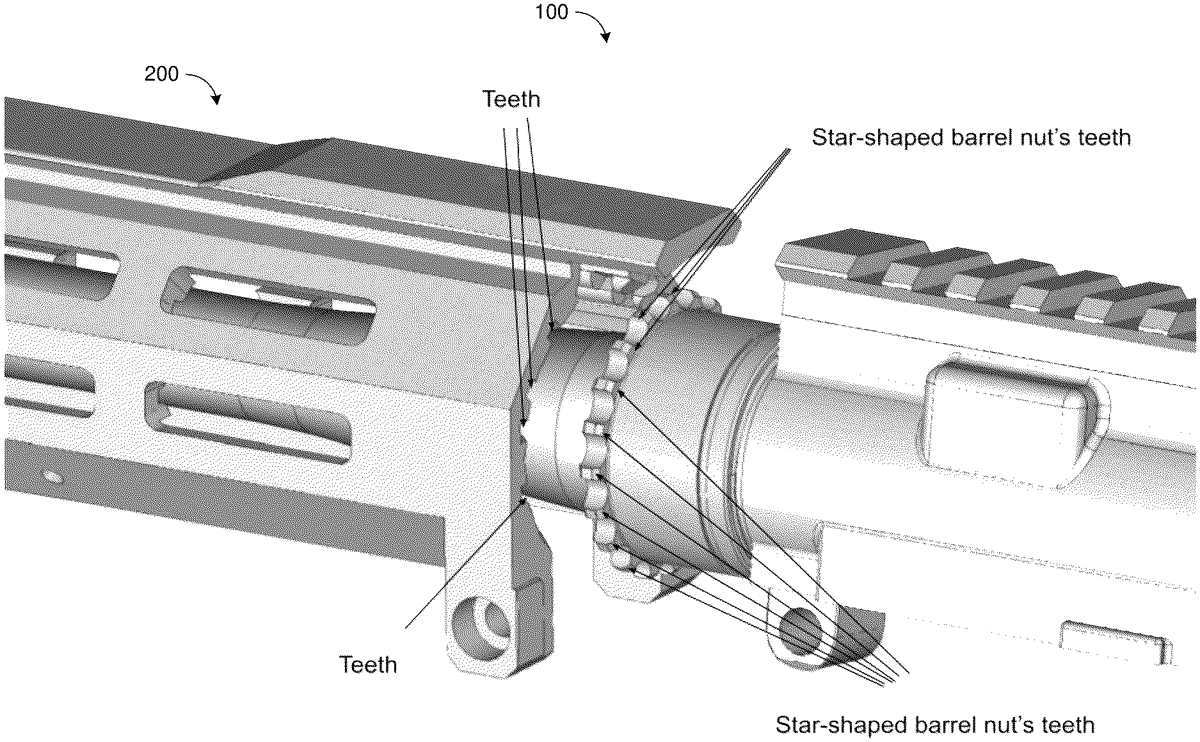
The patent describes a handguard designed for firearms that encircles a portion of the barrel and features interlocking mechanisms with a star-shaped barrel nut for secure attachment. The installation process involves rotating and sliding the handguard to align its internal slots with the barrel nut’s teeth, ensuring a stable fit.
Claim 1
1 . A device implementable on a firearm, comprising: a handguard, wherein, when the handguard is installed on the firearm: the handguard is configured to surround at least a portion of a barrel of the firearm; the handguard has a first distal end and a second distal end opposite the first distal end such that the first distal end points in a direction of a muzzle of the firearm and the second distal end points toward an upper receiver of the firearm; and the second distal end is configured with physical features that interlock with a star-shaped barrel nut of the firearm to secure the handguard onto the firearm, wherein the physical features comprise: longitudinal slots on an internal surface of the handguard near the second distal end thereof such that a contour of the internal surface of the handguard at the second distal end resembles teeth of an internal ring gear; and grooves on a ridge of at least some of the teeth at a predefined distance from a mating surface at the second distal end of the handguard which contacts a delta ring of the firearm when the handguard is installed on the firearm, wherein the physical features are configured such that, during installation of the handguard on the firearm: the handguard is rotated by a predefined amount in a first direction and then is slid rearwardly along a barrel of the firearm toward the upper receiver of the firearm to allow teeth of a star-shaped barrel nut of the firearm to enter and slide through the longitudinal slots until some of the teeth of the star-shaped barrel nut are aligned with the grooves; and the handguard is then rotated by the predefined amount in a second direction opposite the first direction so that the teeth of the star-shaped barrel nut remain inside the grooves to secure the handguard onto the firearm. a handguard, wherein, when the handguard is installed on the firearm: the handguard is configured to surround at least a portion of a barrel of the firearm; the handguard has a first distal end and a second distal end opposite the first distal end such that the first distal end points in a direction of a muzzle of the firearm and the second distal end points toward an upper receiver of the firearm; and the second distal end is configured with physical features that interlock with a star-shaped barrel nut of the firearm to secure the handguard onto the firearm, wherein the physical features comprise: longitudinal slots on an internal surface of the handguard near the second distal end thereof such that a contour of the internal surface of the handguard at the second distal end resembles teeth of an internal ring gear; and grooves on a ridge of at least some of the teeth at a predefined distance from a mating surface at the second distal end of the handguard which contacts a delta ring of the firearm when the handguard is installed on the firearm, the handguard is configured to surround at least a portion of a barrel of the firearm; the handguard has a first distal end and a second distal end opposite the first distal end such that the first distal end points in a direction of a muzzle of the firearm and the second distal end points toward an upper receiver of the firearm; and the second distal end is configured with physical features that interlock with a star-shaped barrel nut of the firearm to secure the handguard onto the firearm, wherein the physical features comprise: longitudinal slots on an internal surface of the handguard near the second distal end thereof such that a contour of the internal surface of the handguard at the second distal end resembles teeth of an internal ring gear; and grooves on a ridge of at least some of the teeth at a predefined distance from a mating surface at the second distal end of the handguard which contacts a delta ring of the firearm when the handguard is installed on the firearm, wherein the physical features are configured such that, during installation of the handguard on the firearm: the handguard is rotated by a predefined amount in a first direction and then is slid rearwardly along a barrel of the firearm toward the upper receiver of the firearm to allow teeth of a star-shaped barrel nut of the firearm to enter and slide through the longitudinal slots until some of the teeth of the star-shaped barrel nut are aligned with the grooves; and the handguard is then rotated by the predefined amount in a second direction opposite the first direction so that the teeth of the star-shaped barrel nut remain inside the grooves to secure the handguard onto the firearm. the handguard is rotated by a predefined amount in a first direction and then is slid rearwardly along a barrel of the firearm toward the upper receiver of the firearm to allow teeth of a star-shaped barrel nut of the firearm to enter and slide through the longitudinal slots until some of the teeth of the star-shaped barrel nut are aligned with the grooves; and the handguard is then rotated by the predefined amount in a second direction opposite the first direction so that the teeth of the star-shaped barrel nut remain inside the grooves to secure the handguard onto the firearm.
Google Patents
https://patents.google.com/patent/US12747930
USPTO PDF
https://image-ppubs.uspto.gov/dirsearch-public/print/downloadPdf/12747930