US12736311 - Method for protecting an object from a radar-guided missile
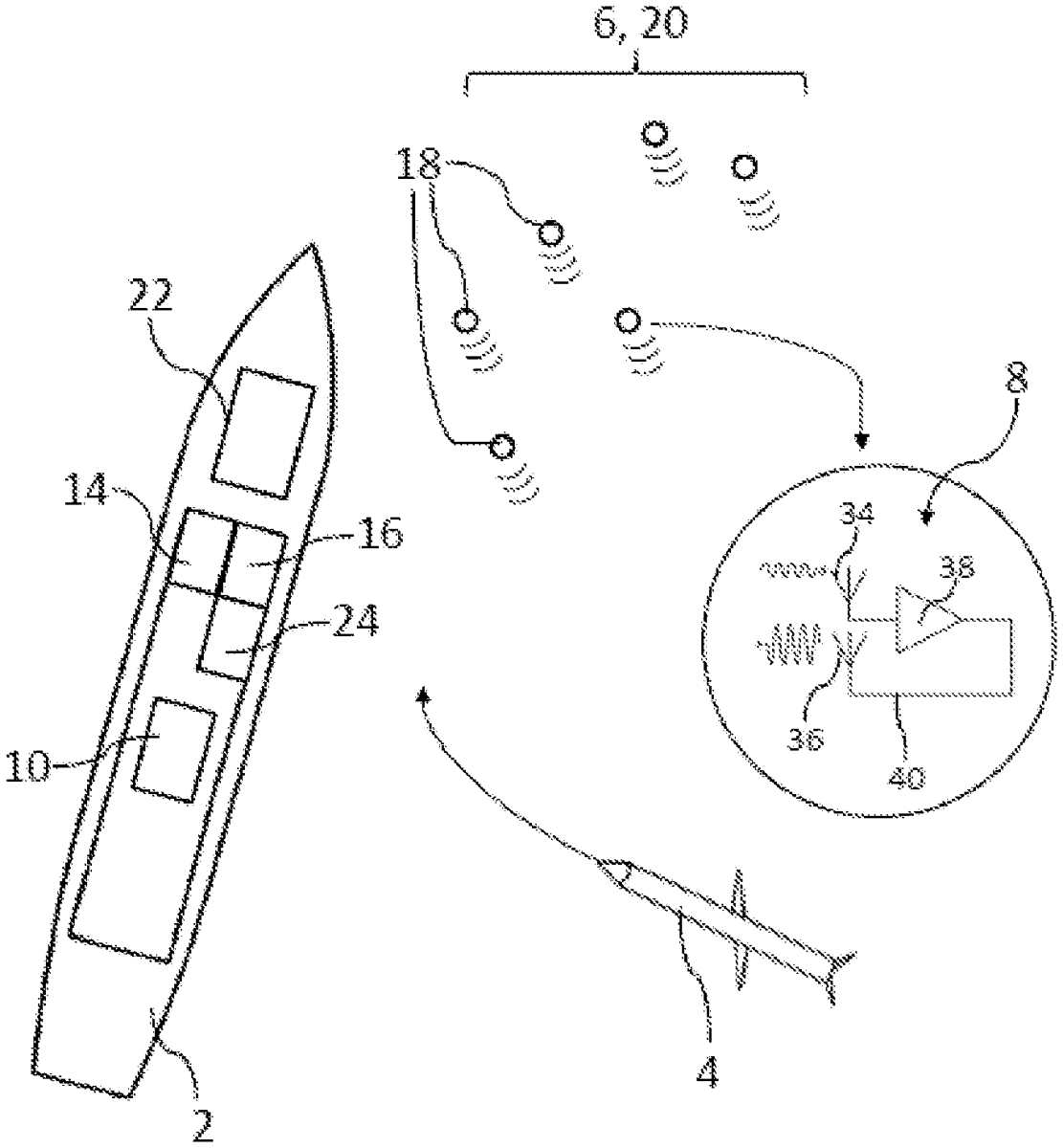
The patent describes a method for protecting vehicles or ships from radar-guided missiles by deploying multiple drones equipped with active offboard reflectors that can detect and amplify radar signals. These drones are strategically positioned to create a radar scatter pattern that mimics the protected object, thereby misleading the missile.
Claim 1
1 . A method for protecting an object from a radar-guided missile, the method comprising: detecting, on the object to be protected, an incoming radar-guided missile and ascertaining at least a direction of approach of the radar-guided missile; deploying a plurality of flying drones from the object to be protected or from an accompanying vehicle carrying the drones by means of an electronically controlled throwing device, each drone having at least one active offboard reflector, the active offboard reflector comprising at least one receiving antenna, at least one transmitting antenna and an intermediately connected device for amplifying a received radar signal, wherein a direction, speed, and/or distance of the deployment relative to the object to be protected are determined as a function of the ascertained direction of approach of the incoming radar-guided missile, and wherein the drones are brought into the air by means of the electronically controlled throwing device according to a previously calculated decoy pattern; for a respective drone, ascertaining its current actual position relative to its starting position on the object to be protected or on the accompanying vehicle, comparing the current actual position to a previously calculated reference position according to the decoy pattern, and controlling a flight drive mechanism of the drone by means of an electronic flight drive control device such that the drone assumes the previously calculated reference position; and at each drone, picking up a radar signal transmitted by the radar-guided missile via the at least one receiving antenna, amplifying the received radar signal, and transmitting the amplified radar signal via the at least one transmitting antenna in a direction opposite to a direction of reception of the radar signal back to the missile, wherein the drones are positioned relative to one another in space such that the active offboard reflectors thereof act as individual scattering centers, and the amplified signals returned to the missile collectively produce a radar scatter pattern that simulates the object to be protected. detecting, on the object to be protected, an incoming radar-guided missile and ascertaining at least a direction of approach of the radar-guided missile; deploying a plurality of flying drones from the object to be protected or from an accompanying vehicle carrying the drones by means of an electronically controlled throwing device, each drone having at least one active offboard reflector, the active offboard reflector comprising at least one receiving antenna, at least one transmitting antenna and an intermediately connected device for amplifying a received radar signal, wherein a direction, speed, and/or distance of the deployment relative to the object to be protected are determined as a function of the ascertained direction of approach of the incoming radar-guided missile, and wherein the drones are brought into the air by means of the electronically controlled throwing device according to a previously calculated decoy pattern; for a respective drone, ascertaining its current actual position relative to its starting position on the object to be protected or on the accompanying vehicle, comparing the current actual position to a previously calculated reference position according to the decoy pattern, and controlling a flight drive mechanism of the drone by means of an electronic flight drive control device such that the drone assumes the previously calculated reference position; and at each drone, picking up a radar signal transmitted by the radar-guided missile via the at least one receiving antenna, amplifying the received radar signal, and transmitting the amplified radar signal via the at least one transmitting antenna in a direction opposite to a direction of reception of the radar signal back to the missile, wherein the drones are positioned relative to one another in space such that the active offboard reflectors thereof act as individual scattering centers, and the amplified signals returned to the missile collectively produce a radar scatter pattern that simulates the object to be protected.
Google Patents
https://patents.google.com/patent/US12736311
USPTO PDF
https://image-ppubs.uspto.gov/dirsearch-public/print/downloadPdf/12736311