US12710257 - Enhanced payload delivery
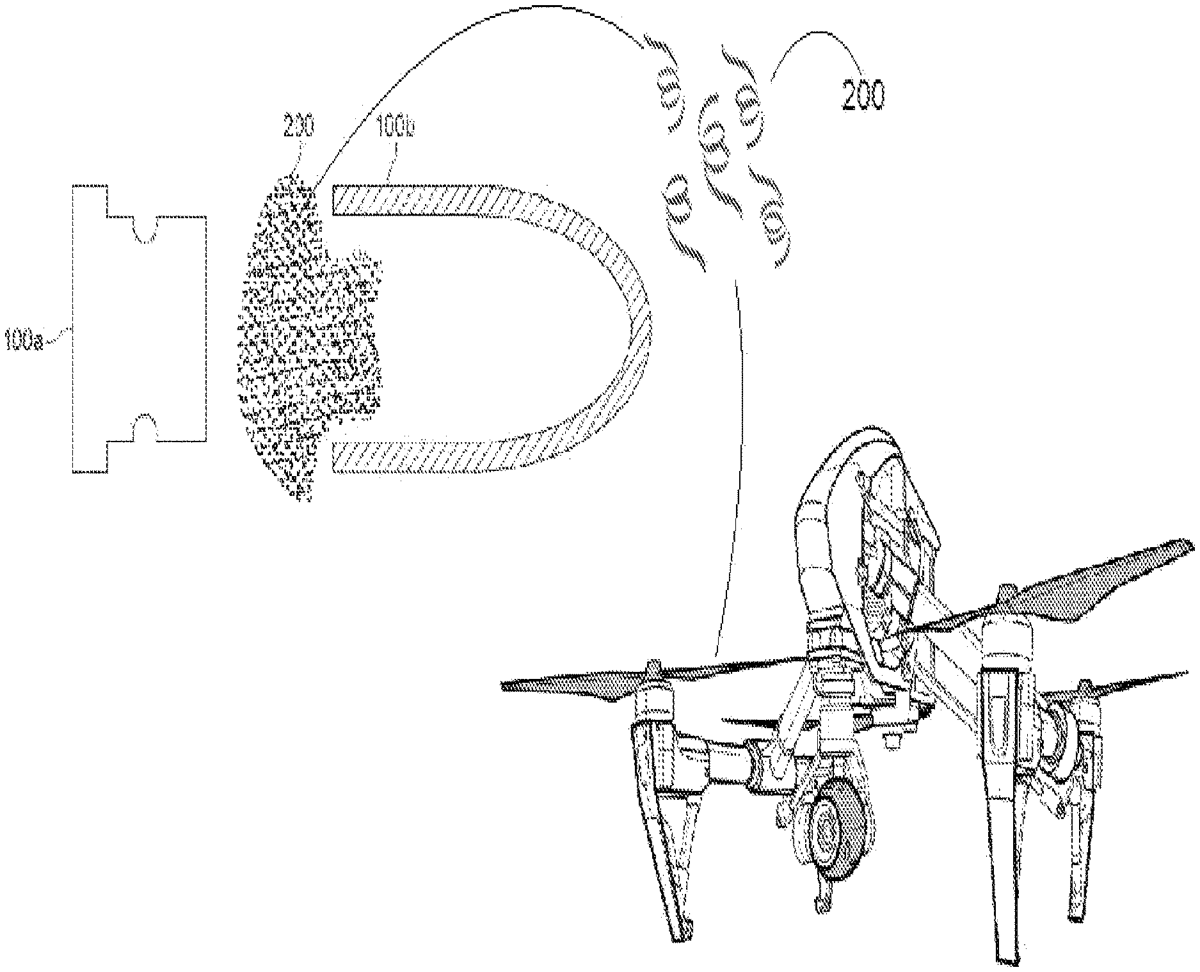
The patent describes a device designed to deploy a set of payloads during its trajectory, utilizing a mechanism that activates in response to inductive energy generated by motion through a magnetic field. The payloads can interact with airborne devices through various methods and include visual cues to indicate release paths or interaction regions.
Claim 1
1 . A device configured to travel along a trajectory, the device comprising: a set of payloads configured to interact with at least one of an airborne device or a component of the airborne device via at least one of physical entanglement, sensor obscuration, or surface adhesion; and a mechanism operable between an inactive state and an active state, wherein the mechanism is configured to: transition to the active state in response to inductive energy generated by relative motion through a magnetic field during launch, and deploy the set of payloads based on at least one of: one or more elapsed times during travel of the device along the trajectory, one or more positions of the device along the trajectory, or one or more distances traveled by the device along the trajectory, wherein at least one payload of the set of payloads includes a set of visual cues including at least one of the physical entanglement, a tracer compound, a color-coded dye, or a phosphorescent marker, the set of visual cues being configured to indicate at least one of a release path or an interaction region. a set of payloads configured to interact with at least one of an airborne device or a component of the airborne device via at least one of physical entanglement, sensor obscuration, or surface adhesion; and a mechanism operable between an inactive state and an active state, wherein the mechanism is configured to: transition to the active state in response to inductive energy generated by relative motion through a magnetic field during launch, and deploy the set of payloads based on at least one of: one or more elapsed times during travel of the device along the trajectory, one or more positions of the device along the trajectory, or one or more distances traveled by the device along the trajectory, wherein at least one payload of the set of payloads includes a set of visual cues including at least one of the physical entanglement, a tracer compound, a color-coded dye, or a phosphorescent marker, the set of visual cues being configured to indicate at least one of a release path or an interaction region. transition to the active state in response to inductive energy generated by relative motion through a magnetic field during launch, and deploy the set of payloads based on at least one of: one or more elapsed times during travel of the device along the trajectory, one or more positions of the device along the trajectory, or one or more distances traveled by the device along the trajectory, one or more elapsed times during travel of the device along the trajectory, one or more positions of the device along the trajectory, or one or more distances traveled by the device along the trajectory, wherein at least one payload of the set of payloads includes a set of visual cues including at least one of the physical entanglement, a tracer compound, a color-coded dye, or a phosphorescent marker, the set of visual cues being configured to indicate at least one of a release path or an interaction region.
Google Patents
https://patents.google.com/patent/US12710257
USPTO PDF
https://image-ppubs.uspto.gov/dirsearch-public/print/downloadPdf/12710257