US12698946 - Adjustable firearm stock with passive tensioning mechanism
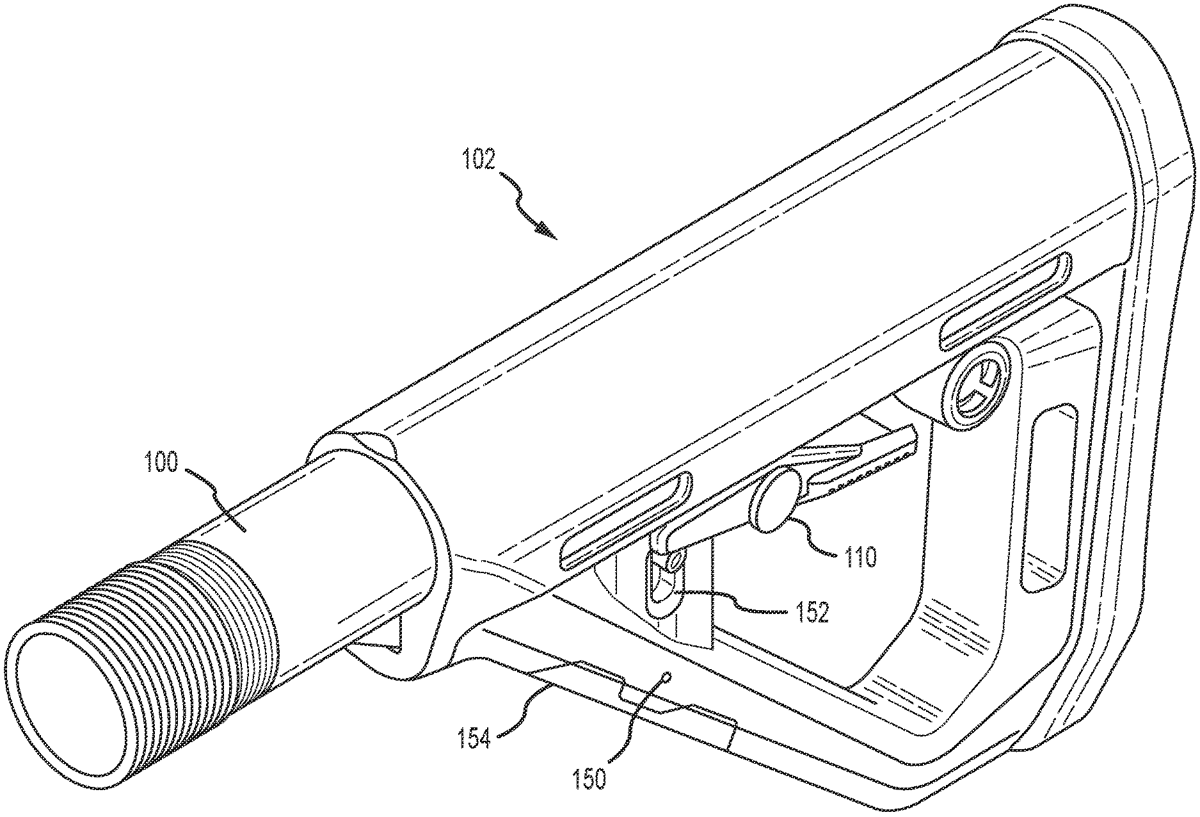
The patent describes an adjustable firearm stock featuring a passive tensioning mechanism that allows for easy longitudinal adjustment on a buffer tube while compensating for rotational tolerances. The mechanism includes a tensioning block and indexing pin that can be independently engaged and disengaged through a lever-operated system, enhancing the stock’s adaptability and stability.
Claim 1
1 . An adjustable stock assembly for a firearm, comprising: a stock body configured to couple to a buffer tube of the firearm; a tensioning mechanism within the stock body, comprising: a tensioning body configured to couple to the stock body; an indexing pin slidably arranged within an aperture in the tensioning body and having a first spring coupled within the indexing pin; a first retaining pin coupled through a first set of apertures in the indexing pin and coupled through two additional apertures within the tensioning body, and wherein a first end of the first spring abuts to a bottom portion of the first retaining pin; and a second retaining pin coupled through a second set of apertures in the indexing pin, wherein a second end of the first spring abuts to a top portion of the second retaining pin; and a second spring coupled around the indexing pin between the tensioning body and the second retaining pin. a stock body configured to couple to a buffer tube of the firearm; a tensioning mechanism within the stock body, comprising: a tensioning body configured to couple to the stock body; an indexing pin slidably arranged within an aperture in the tensioning body and having a first spring coupled within the indexing pin; a first retaining pin coupled through a first set of apertures in the indexing pin and coupled through two additional apertures within the tensioning body, and wherein a first end of the first spring abuts to a bottom portion of the first retaining pin; and a second retaining pin coupled through a second set of apertures in the indexing pin, wherein a second end of the first spring abuts to a top portion of the second retaining pin; and a second spring coupled around the indexing pin between the tensioning body and the second retaining pin.
Google Patents
https://patents.google.com/patent/US12698946
USPTO PDF
https://image-ppubs.uspto.gov/dirsearch-public/print/downloadPdf/12698946