US12680792 - Compact supersonic projectile tracking
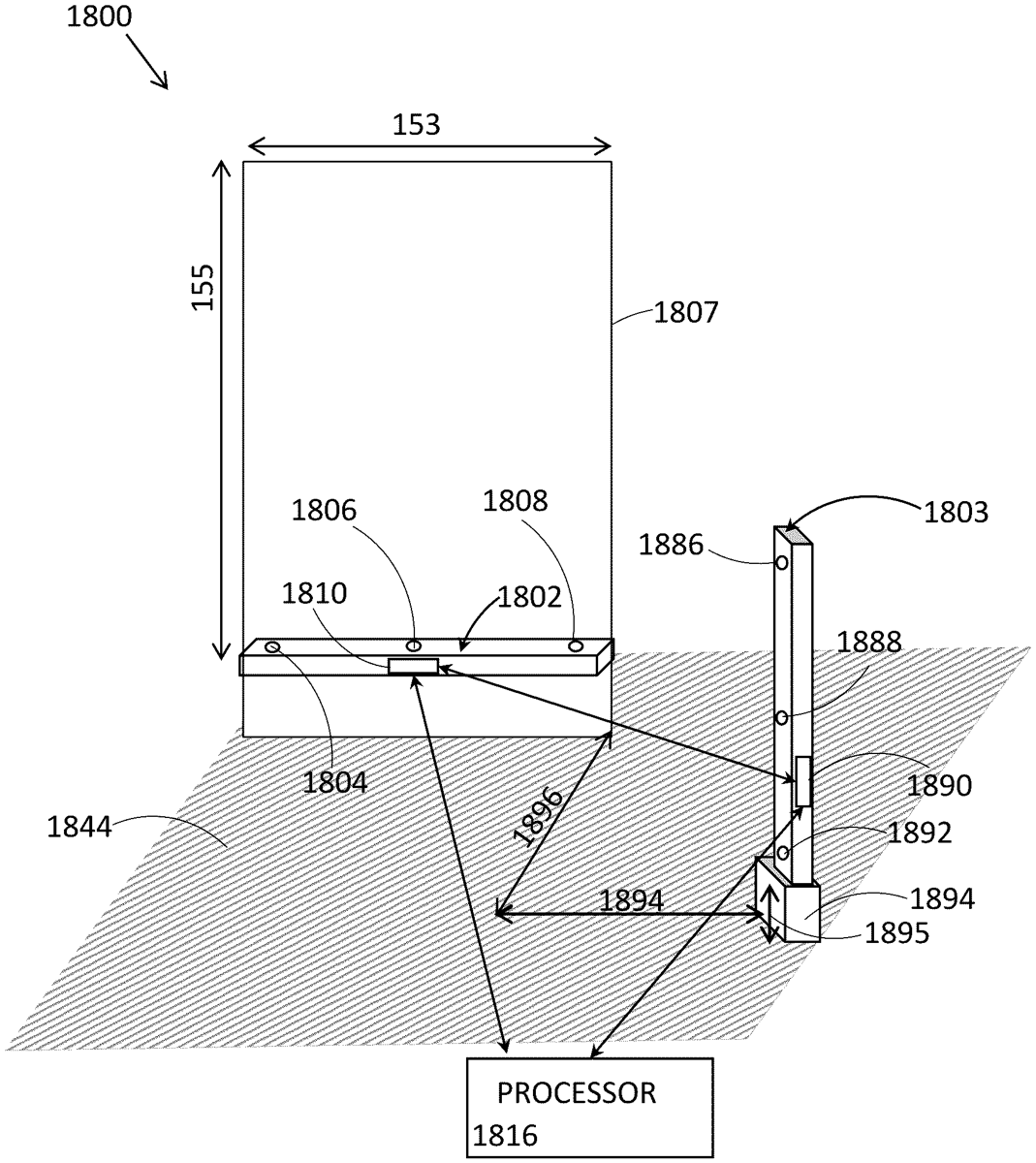
The patent describes a projectile tracking system utilizing a network of acoustic sensors to detect the timing of supersonic shockwaves and their reflections from a surface, allowing for trajectory determination. The configuration ensures that the distance between sensors and the reflective surface is optimized to facilitate accurate measurements while accounting for the sensors’ response times.
Claim 1
1 . A projectile tracking system comprising: a plurality of acoustic sensors rigidly held apart from each other and each acoustic sensor of the plurality of acoustic sensors is held apart from an acoustically reflective surface by a respective shortest straight line distance selected so that, for the respective acoustic sensor a time between arrival of a supersonic shockwave of a projectile at the respective acoustic sensor and arrival of a reflection of said supersonic shockwave from said acoustically reflective surface at the respective acoustic sensor is at least a sensing relaxation time of the respective acoustic sensor, said respective shortest straight line distance being at least double said sensing relaxation time multiplied by a speed of sound, the sensing relaxation time defined as a time delay after sensing of a first shockwave at which a sensor is able to detect a second shockwave; a processor configured to: receive a spatial relationship between said plurality of acoustic sensors and a spatial relationship between said plurality of acoustic sensors and said acoustically reflective surface; receive a plurality of measurement signals comprising a measurement signal corresponding to each of said plurality of acoustic sensors; identify: in at least one single measurement signal of said plurality of measurement signals, timing of arrival of a supersonic shockwave of a projectile to the respective sensor; and in said at least one single, timing of arrival of a reflection of said supersonic shockwave from said acoustically reflective surface to the respective sensor; determine at least a portion of a trajectory of the projectile, using: said timing of arrival of said supersonic shockwave; said timing of arrival of said reflection; said spatial relationship between said plurality of acoustic sensors; and said spatial relationship between said plurality of acoustic sensors and said acoustically reflective surface. a plurality of acoustic sensors rigidly held apart from each other and each acoustic sensor of the plurality of acoustic sensors is held apart from an acoustically reflective surface by a respective shortest straight line distance selected so that, for the respective acoustic sensor a time between arrival of a supersonic shockwave of a projectile at the respective acoustic sensor and arrival of a reflection of said supersonic shockwave from said acoustically reflective surface at the respective acoustic sensor is at least a sensing relaxation time of the respective acoustic sensor, said respective shortest straight line distance being at least double said sensing relaxation time multiplied by a speed of sound, the sensing relaxation time defined as a time delay after sensing of a first shockwave at which a sensor is able to detect a second shockwave; a processor configured to: receive a spatial relationship between said plurality of acoustic sensors and a spatial relationship between said plurality of acoustic sensors and said acoustically reflective surface; receive a plurality of measurement signals comprising a measurement signal corresponding to each of said plurality of acoustic sensors; identify: in at least one single measurement signal of said plurality of measurement signals, timing of arrival of a supersonic shockwave of a projectile to the respective sensor; and in said at least one single, timing of arrival of a reflection of said supersonic shockwave from said acoustically reflective surface to the respective sensor; determine at least a portion of a trajectory of the projectile, using: said timing of arrival of said supersonic shockwave; said timing of arrival of said reflection; said spatial relationship between said plurality of acoustic sensors; and said spatial relationship between said plurality of acoustic sensors and said acoustically reflective surface. receive a spatial relationship between said plurality of acoustic sensors and a spatial relationship between said plurality of acoustic sensors and said acoustically reflective surface; receive a plurality of measurement signals comprising a measurement signal corresponding to each of said plurality of acoustic sensors; identify: in at least one single measurement signal of said plurality of measurement signals, timing of arrival of a supersonic shockwave of a projectile to the respective sensor; and in said at least one single, timing of arrival of a reflection of said supersonic shockwave from said acoustically reflective surface to the respective sensor; in at least one single measurement signal of said plurality of measurement signals, timing of arrival of a supersonic shockwave of a projectile to the respective sensor; and in said at least one single, timing of arrival of a reflection of said supersonic shockwave from said acoustically reflective surface to the respective sensor; determine at least a portion of a trajectory of the projectile, using: said timing of arrival of said supersonic shockwave; said timing of arrival of said reflection; said spatial relationship between said plurality of acoustic sensors; and said spatial relationship between said plurality of acoustic sensors and said acoustically reflective surface. said timing of arrival of said supersonic shockwave; said timing of arrival of said reflection; said spatial relationship between said plurality of acoustic sensors; and said spatial relationship between said plurality of acoustic sensors and said acoustically reflective surface.
Google Patents
https://patents.google.com/patent/US12680792
USPTO PDF
https://image-ppubs.uspto.gov/dirsearch-public/print/downloadPdf/12680792