US12669311 - Ballistic block for a bullet resistant glazing
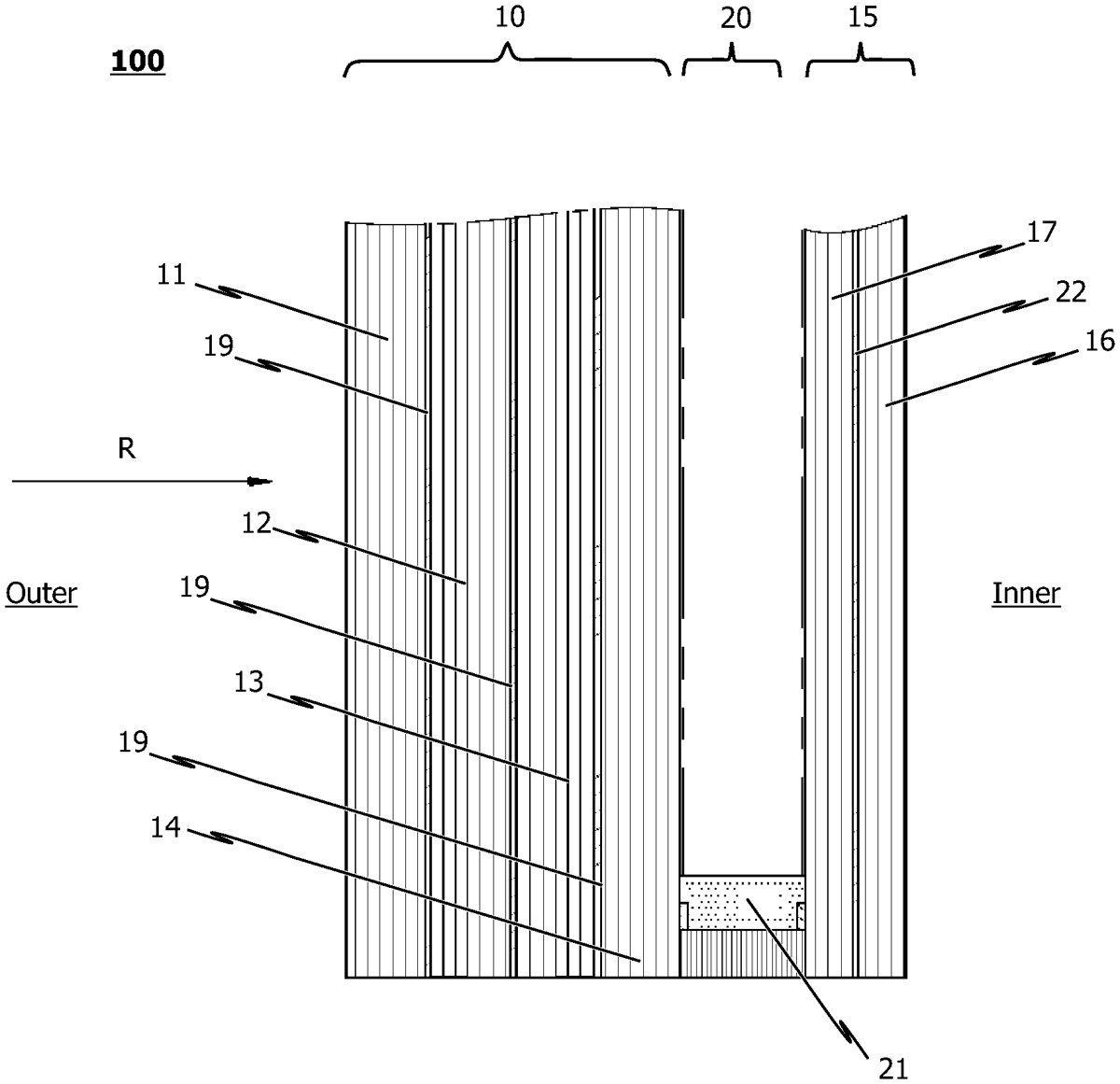
The patent describes a ballistic block designed for bullet-resistant glazing, consisting of at least two heat-strengthened glass panes joined by an ionoplast polymer interlayer, without additional energy-absorbing layers or polycarbonate. This construction allows the ballistic block to be a self-supporting unit, eliminating hollow spaces between the panes and enabling installation supported on only two sides.
Claim 1
1 . A ballistic block for a bullet-resistant glazing, wherein the ballistic block comprises at least two transparent panes joined to one another by an interlayer, wherein the interlayer is composed of at least partly or partially from an ionoplast polymer, a first side defined by one of the at least two transparent panes, a second side opposite the first side, wherein the second side is defined by another one of the at least two transparent panes, wherein the ballistic block does not include a further energy-absorbing layer on the first side, wherein ballistic block does not include any polycarbonate, and wherein the at least two transparent panes are each made of heat-strengthened glass having a flexural strength of 70 N/mm 2 to 120 N/mm 2 , wherein the ballistic block does not include a hollow space between any of the at least two transparent panes from the first side to the second side, and wherein the at least two transparent panes are combined by the interlayer into one structurally self-supporting unit such that when the ballistic block is installed, the ballistic block is retained on no more than two sides of the ballistic block. at least two transparent panes joined to one another by an interlayer, wherein the interlayer is composed of at least partly or partially from an ionoplast polymer, a first side defined by one of the at least two transparent panes, a second side opposite the first side, wherein the second side is defined by another one of the at least two transparent panes, wherein the ballistic block does not include a further energy-absorbing layer on the first side, wherein ballistic block does not include any polycarbonate, and wherein the at least two transparent panes are each made of heat-strengthened glass having a flexural strength of 70 N/mm 2 to 120 N/mm 2 , wherein the ballistic block does not include a hollow space between any of the at least two transparent panes from the first side to the second side, and wherein the second side is defined by another one of the at least two transparent panes, wherein the ballistic block does not include a further energy-absorbing layer on the first side, wherein ballistic block does not include any polycarbonate, and wherein the at least two transparent panes are each made of heat-strengthened glass having a flexural strength of 70 N/mm 2 to 120 N/mm 2 , wherein the ballistic block does not include a hollow space between any of the at least two transparent panes from the first side to the second side, and wherein the at least two transparent panes are combined by the interlayer into one structurally self-supporting unit such that when the ballistic block is installed, the ballistic block is retained on no more than two sides of the ballistic block.
Google Patents
https://patents.google.com/patent/US12669311
USPTO PDF
https://image-ppubs.uspto.gov/dirsearch-public/print/downloadPdf/12669311