US12663248 - Method for evaluating deep-buried tunnel blasting parameters
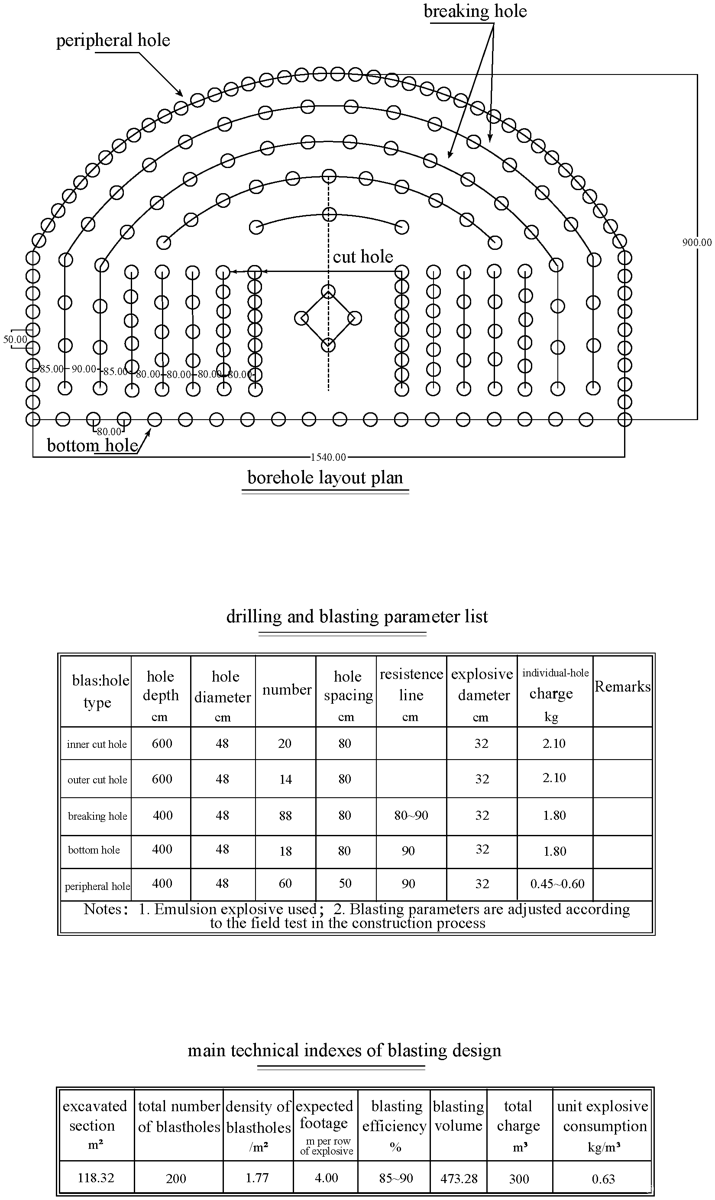
The patent describes a method for evaluating blasting parameters in deep-buried tunnels by implementing multiple blasting schemes across test sections with identical geological characteristics. It involves collecting and comparing various monitoring data to determine the optimal blasting scheme, ensuring safety and quality in tunnel excavation.
Claim 1
1 . A method for evaluating deep-buried tunnel blasting parameters, comprising: setting at least two different blasting schemes; selecting at least two test sections with same geological characteristics, the at least two different blasting schemes corresponding to the at least two test sections, respectively, and a number of the at least two test sections corresponding to a number of the at least two different blasting schemes; blasting the at least two test sections using the at least two different blasting schemes, respectively, and obtaining various monitoring data of each of the at least two test sections, wherein the various monitoring data include a vector resultant velocity and a risk distance, an unblasted hole rate, a rock wave velocity and a broken rock zone thickness, overbreak and underbreak situations of typical fracture surfaces of the each of the at least two test sections; and comparing the obtained various monitoring data among the at least two test sections to select an optimal blasting schemes for the at least two test sections; wherein the obtaining various monitoring data of each of the at least two test sections comprises: conducting blast vibration monitoring, broken rock zone monitoring, and three-dimensional laser scanning on the at least two test sections; calculating the vector resultant velocity and the risk distance based on vibration monitoring data obtained from the blast vibration monitoring; calculating the unblasted hole rate; calculating the rock wave velocity and the broken rock zone thickness based on acoustic wave test results of broken rock zone monitoring; and obtaining the overbreak and underbreak situations of typical fracture surfaces based on 3D point cloud data obtained from the three-dimensional laser scanning. setting at least two different blasting schemes; selecting at least two test sections with same geological characteristics, the at least two different blasting schemes corresponding to the at least two test sections, respectively, and a number of the at least two test sections corresponding to a number of the at least two different blasting schemes; blasting the at least two test sections using the at least two different blasting schemes, respectively, and obtaining various monitoring data of each of the at least two test sections, wherein the various monitoring data include a vector resultant velocity and a risk distance, an unblasted hole rate, a rock wave velocity and a broken rock zone thickness, overbreak and underbreak situations of typical fracture surfaces of the each of the at least two test sections; and comparing the obtained various monitoring data among the at least two test sections to select an optimal blasting schemes for the at least two test sections; wherein the obtaining various monitoring data of each of the at least two test sections comprises: conducting blast vibration monitoring, broken rock zone monitoring, and three-dimensional laser scanning on the at least two test sections; calculating the vector resultant velocity and the risk distance based on vibration monitoring data obtained from the blast vibration monitoring; calculating the unblasted hole rate; calculating the rock wave velocity and the broken rock zone thickness based on acoustic wave test results of broken rock zone monitoring; and obtaining the overbreak and underbreak situations of typical fracture surfaces based on conducting blast vibration monitoring, broken rock zone monitoring, and three-dimensional laser scanning on the at least two test sections; calculating the vector resultant velocity and the risk distance based on vibration monitoring data obtained from the blast vibration monitoring; calculating the unblasted hole rate; calculating the rock wave velocity and the broken rock zone thickness based on acoustic wave test results of broken rock zone monitoring; and obtaining the overbreak and underbreak situations of typical fracture surfaces based on 3D point cloud data obtained from the three-dimensional laser scanning.
Google Patents
https://patents.google.com/patent/US12663248
USPTO PDF
https://image-ppubs.uspto.gov/dirsearch-public/print/downloadPdf/12663248