US12663234 - System and method for proximity based assignment
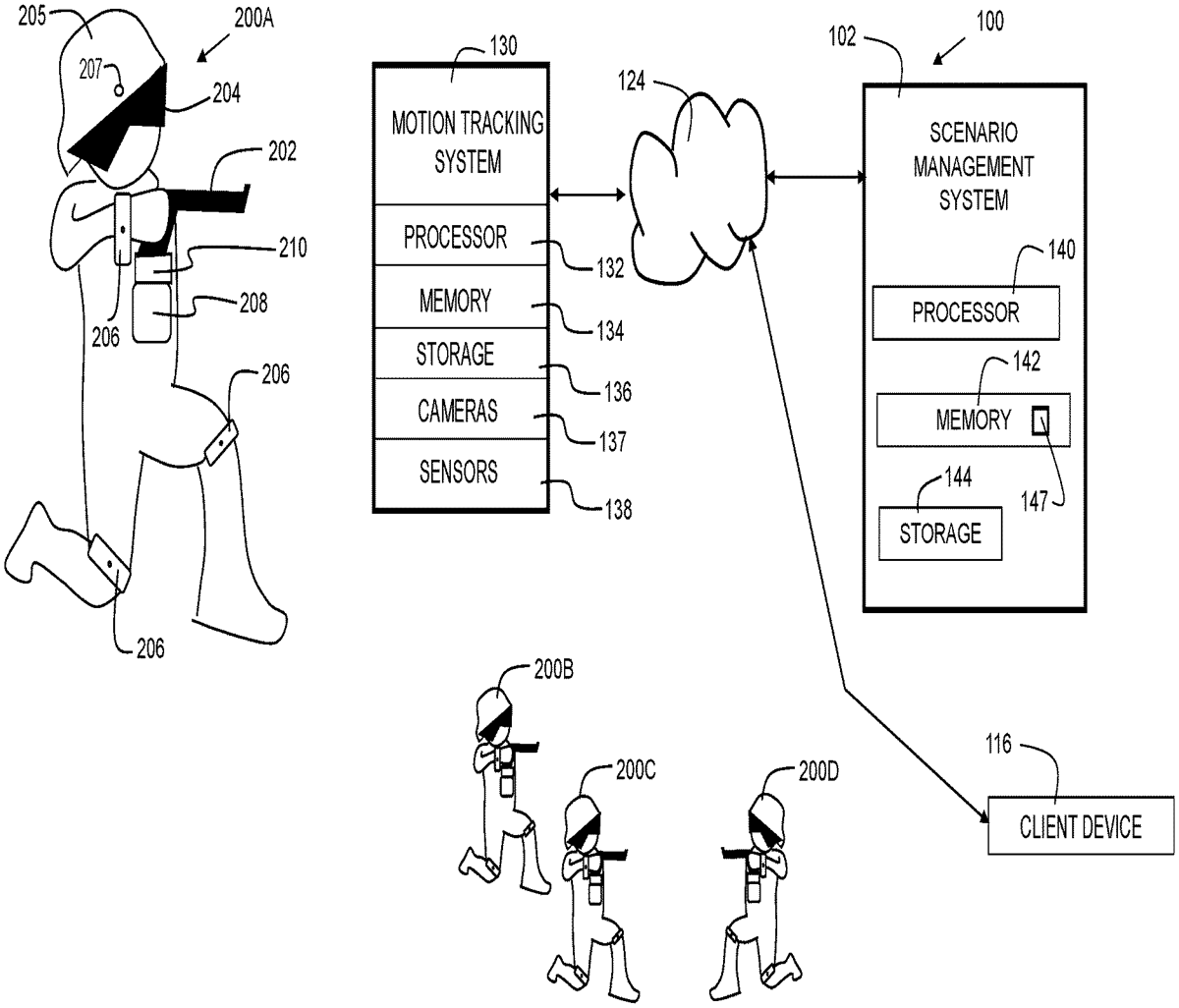
The patent describes a system for simulating firearm usage through motion tracking and wearable sensors, enabling evaluation of user performance in various scenarios. It includes features such as head-mounted displays, avatar generation, and threat detection to analyze user reactions during the simulation.
Claim 1
1 . A computer-implemented method executed by a system for conducting a firearm usage simulation, comprising: assigning one or more head mounted displays (HMDs) to one or more users participating in the firearm usage simulation; detecting a position of each HMD; calibrating a plurality of tracked devices corresponding to each user, wherein the tracked devices include one or more wearable sensors and a weapon simulator; determining which tracked devices correspond to which user by detecting the tracked devices that are in closest proximity to the HMD assigned to each user and associating those devices with the respective user; generating an avatar corresponding to each user; determining, by a motion tracker component, an initial position and subsequent motion and posture of a user, wherein the motion tracker component comprises one or more cameras deployed in an area of the simulation, the one or more cameras being configured to track infrared light emitted from the one or more wearable sensors worn by the user; determining, by the motion tracker component, the one or more wearable sensors, and a user-facing camera included within goggles worn by the user, an initial physiological orientation of the user, wherein a subset of the one or more wearable sensors are affixed to the HMD and are affixed to one or more limbs of the user, wherein each user is represented by their corresponding avatar in the simulation, wherein the avatar’s position, posture and motion in the simulation reflects the user’s position, posture and motion; detecting one or more threats to the user including a weapon discharge in the simulation; and determining, by a data analysis component, a reaction of the user in response to the threats and whether the user discharged their weapon simulator. assigning one or more head mounted displays (HMDs) to one or more users participating in the firearm usage simulation; detecting a position of each HMD; calibrating a plurality of tracked devices corresponding to each user, wherein the tracked devices include one or more wearable sensors and a weapon simulator; determining which tracked devices correspond to which user by detecting the tracked devices that are in closest proximity to the HMD assigned to each user and associating those devices with the respective user; generating an avatar corresponding to each user; determining, by a motion tracker component, an initial position and subsequent motion and posture of a user, wherein the motion tracker component comprises one or more cameras deployed in an area of the simulation, the one or more cameras being configured to track infrared light emitted from the one or more wearable sensors worn by the user; determining, by the motion tracker component, the one or more wearable sensors, and a user-facing camera included within goggles worn by the user, an initial physiological orientation of the user, wherein a subset of the one or more wearable sensors are affixed to the HMD and are affixed to one or more limbs of the user, wherein each user is represented by their corresponding avatar in the simulation, wherein the avatar’s position, posture and motion in the simulation reflects the user’s position, posture and motion; detecting one or more threats to the user including a weapon discharge in the simulation; and determining, by a data analysis component, a reaction of the user in response to the threats and whether the user discharged their weapon simulator.
Google Patents
https://patents.google.com/patent/US12663234
USPTO PDF
https://image-ppubs.uspto.gov/dirsearch-public/print/downloadPdf/12663234