US12624910 - Reduced weapon system blowback
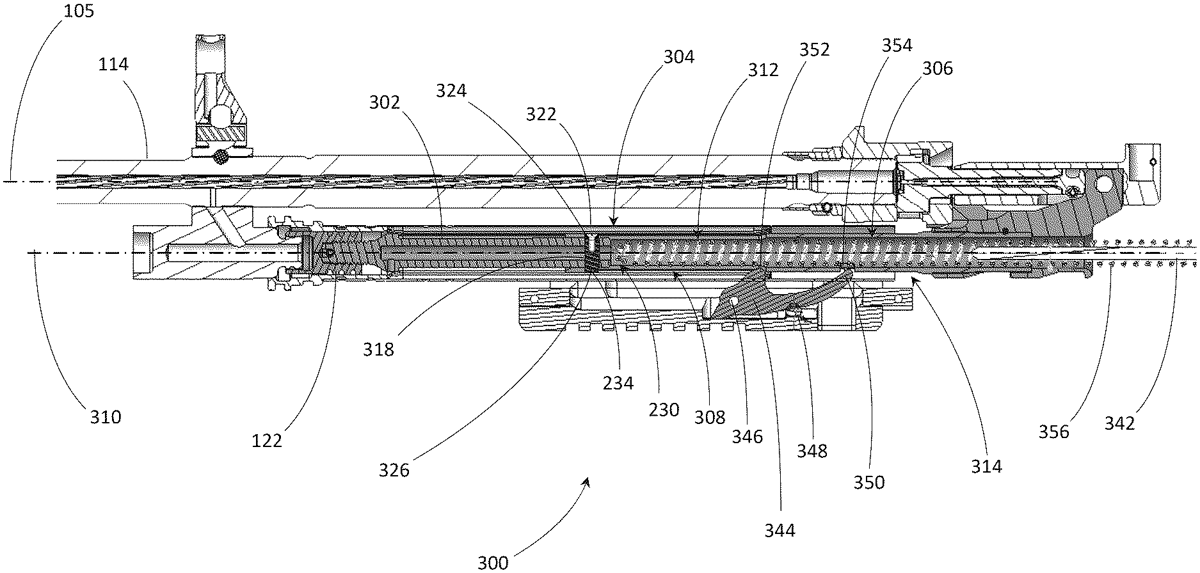
The patent describes a reloading firearm mechanism designed to minimize blowback of toxic propellant gases towards the user by increasing the dwell time of the firing chamber. This is achieved through a multi-segmented reloading assembly that delays breech opening, allowing gas pressure to dissipate before the breech is opened, thereby reducing the exposure of the warfighter to harmful gases.
Claim 1
1 . An operating rod apparatus for a reloading firearm, the operating rod apparatus being translatable from a first forward position corresponding with a closed and locked condition of the firearm breech bolt, to a second rearward position corresponding with an open condition of the firearm breech bolt, the operating rod apparatus comprising: a rod stem, the rod stem being operatively connected at a first forward end thereof to a piston for driving the operating rod apparatus, the rod stem having a second end thereof substantially opposite said first end; a cam associated with the second end of the rod stem; a cylinder having a passage that is in fluid communication with a pressure port located along a barrel of the firearm between a first muzzle end thereof, and a second firing chamber end thereof, the fluid communication being operative to admit propellant gasses of the firearm into the cylinder forward of the piston; an operating tube that is in sliding engagement with the rod stem, the operating tube having a forward first end and a second end substantially opposite the first end, the second end of the operating tube being operatively connected to a bolt carrier mechanism of the reloading firearm; a rod sear that is movable between a first position that constrains movement of the operating tube, and a second position that frees the operating tube to translate; an elastic bias that urges the rod sear into the first position thereof, and is overcome by the action of the cam associated with the second end of the rod stem, said cam displacing the rod sear into the second position thereof; and a return spring biasing the operating rod apparatus towards the first forward position thereof. a rod stem, the rod stem being operatively connected at a first forward end thereof to a piston for driving the operating rod apparatus, the rod stem having a second end thereof substantially opposite said first end; a cam associated with the second end of the rod stem; a cylinder having a passage that is in fluid communication with a pressure port located along a barrel of the firearm between a first muzzle end thereof, and a second firing chamber end thereof, the fluid communication being operative to admit propellant gasses of the firearm into the cylinder forward of the piston; an operating tube that is in sliding engagement with the rod stem, the operating tube having a forward first end and a second end substantially opposite the first end, the second end of the operating tube being operatively connected to a bolt carrier mechanism of the reloading firearm; a rod sear that is movable between a first position that constrains movement of the operating tube, and a second position that frees the operating tube to translate; an elastic bias that urges the rod sear into the first position thereof, and is overcome by the action of the cam associated with the second end of the rod stem, said cam displacing the rod sear into the second position thereof; and a return spring biasing the operating rod apparatus towards the first forward position thereof.
Google Patents
https://patents.google.com/patent/US12624910
USPTO PDF
https://image-ppubs.uspto.gov/dirsearch-public/print/downloadPdf/12624910