US12578159 - Firearm trigger mechanism
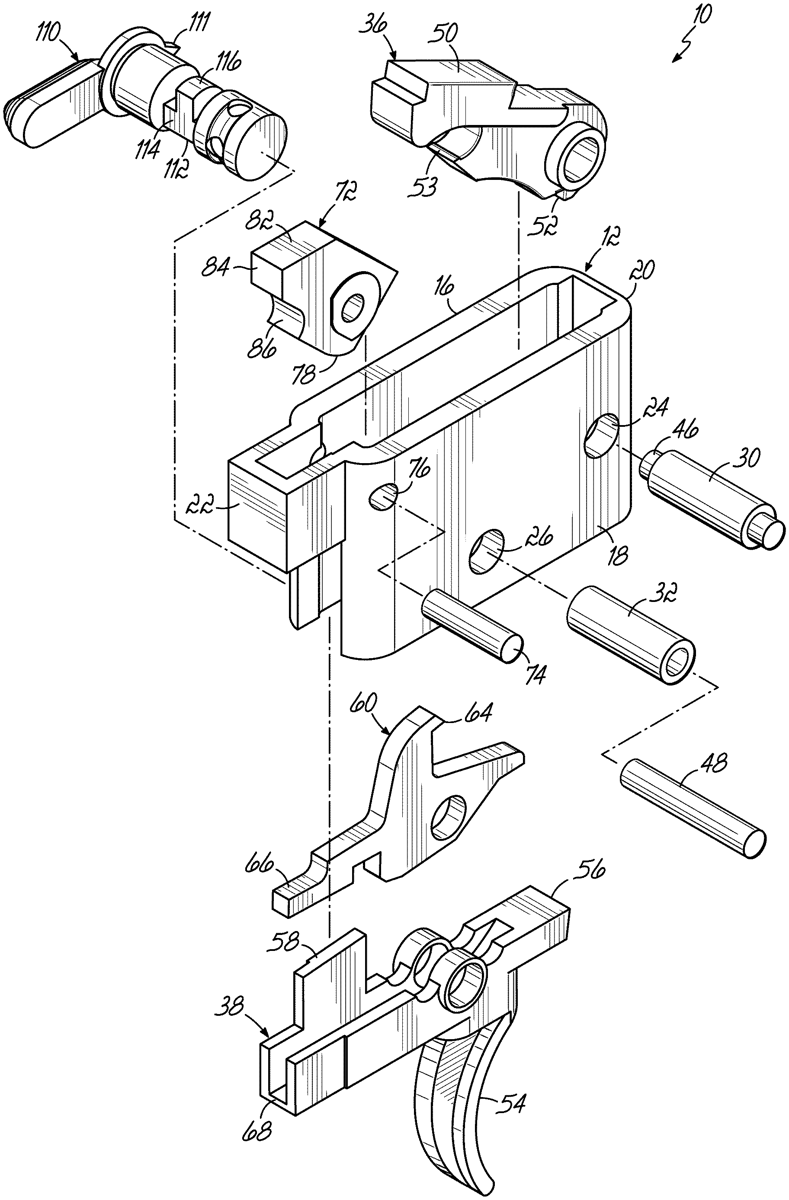
This patent describes a trigger mechanism for AR-pattern firearms that operates in two modes: a standard semi-automatic mode requiring manual release of the trigger and a forced reset semi-automatic mode allowing firing without manual intervention. The mechanism includes a hammer, trigger member, disconnector, and a cam that facilitates the transition between these modes while ensuring safety and functionality.
Claim 1
1 . A firearm trigger mechanism for a firearm having a fire control mechanism pocket and a reciprocating bolt means, the trigger mechanism operable in a first, standard semi-automatic mode and in a second, forced reset semi-automatic mode, the mechanism comprising: a hammer having a hammer sear surface and a hook for engaging a disconnector and adapted to be mounted in the fire control mechanism pocket to pivot on a transverse hammer pivot axis between set and released positions, the hammer adapted to be pivoted rearward by rearward movement of the bolt means, a trigger member having a trigger sear surface and adapted to be mounted in the fire control mechanism pocket to pivot on a transverse trigger member pivot axis between set and released positions, wherein the trigger member sear surface and hammer sear catch surface are in engagement in the set positions of the hammer and trigger member and are out of engagement in the released positions of the hammer and trigger member, the disconnector having a hook for engaging the hammer and adapted to be mounted in the fire control mechanism pocket to pivot on a transverse disconnector pivot axis, and a cam having a cam lobe and adapted to be movably mounted in the fire control mechanism pocket, the cam being movable between a first position and a second position, in the second position the cam lobe forces the trigger member toward the set position, whereupon in the first mode, rearward movement of the bolt means causes rearward pivoting of the hammer such that the disconnector hook catches the hammer hook, and thereafter the bolt means moves forward into battery, at which time a user must manually reduce pressure on the trigger member to free the hammer from the disconnector to permit the hammer and trigger member to pivot to the set positions so that the user can pull the trigger member to fire the firearm, and whereupon in the second mode, rearward movement of the bolt means causes rearward pivoting of the hammer such that the disconnector hook is prevented from holding the hammer, and thereafter the bolt means moves forward into battery, at which time the user can pull the trigger member to fire the firearm. a hammer having a hammer sear surface and a hook for engaging a disconnector and adapted to be mounted in the fire control mechanism pocket to pivot on a transverse hammer pivot axis between set and released positions, the hammer adapted to be pivoted rearward by rearward movement of the bolt means, a trigger member having a trigger sear surface and adapted to be mounted in the fire control mechanism pocket to pivot on a transverse trigger member pivot axis between set and released positions, wherein the trigger member sear surface and hammer sear catch surface are in engagement in the set positions of the hammer and trigger member and are out of engagement in the released positions of the hammer and trigger member, the disconnector having a hook for engaging the hammer and adapted to be mounted in the fire control mechanism pocket to pivot on a transverse disconnector pivot axis, and a cam having a cam lobe and adapted to be movably mounted in the fire control mechanism pocket, the cam being movable between a first position and a second position, in the second position the cam lobe forces the trigger member toward the set position, whereupon in the first mode, rearward movement of the bolt means causes rearward pivoting of the hammer such that the disconnector hook catches the hammer hook, and thereafter the bolt means moves forward into battery, at which time a user must manually reduce pressure on the trigger member to free the hammer from the disconnector to permit the hammer and trigger member to pivot to the set positions so that the user can pull the trigger member to fire the firearm, and whereupon in the second mode, rearward movement of the bolt means causes rearward pivoting of the hammer such that the disconnector hook is prevented from holding the hammer, and thereafter the bolt means moves forward into battery, at which time the user can pull the trigger member to fire the firearm.
Google Patents
https://patents.google.com/patent/US12578159
USPTO PDF
https://image-ppubs.uspto.gov/dirsearch-public/print/downloadPdf/12578159