US12560399 - Bipod
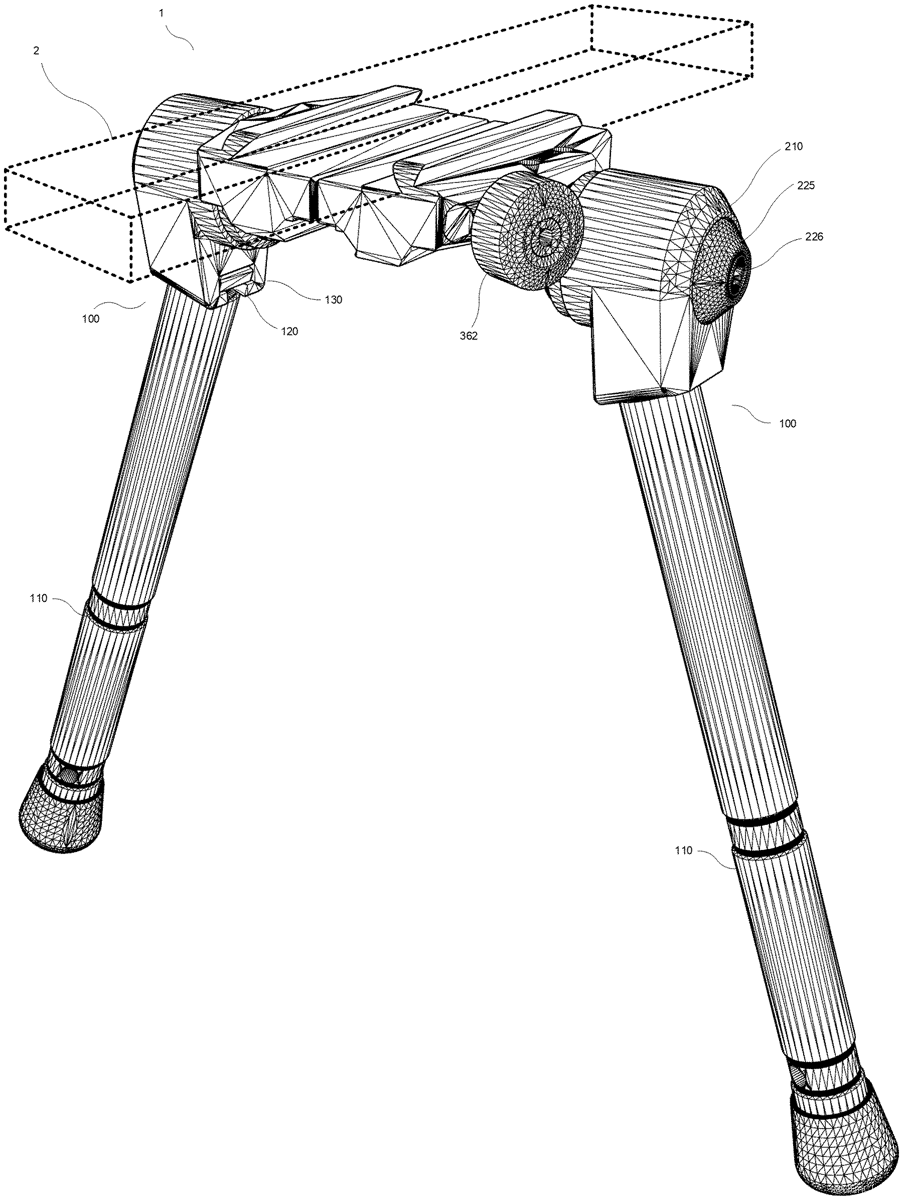
The patent describes an adjustable leg fastening arrangement for a bipod that includes a first and second pivoting part, allowing for pivotable movement between the leg and the bipod main part. It features a conical recess and part that engage frictionally, with a screw mechanism to increase friction as needed, enhancing stability and adjustability.
Claim 1
1 . An adjustable leg fastening arrangement for a bipod, the adjustable leg fastening arrangement comprising: a first pivoting part, arranged to be fastened to a leg part having an axial direction; a second pivoting part, arranged to be fastened to a bipod main part, the second pivoting part being pivotable in relation to the first pivoting part so that the leg part as a result is pivotable in relation to the bipod main part, a conical recess and a conical part, an outer surface of the conical part being arranged to engage in a friction engagement with an inner surface of said conical recess, the conical recess and the conical part each being arranged to be rotationally-fixedly attached to a respective different one of said first pivoting part and said second pivoting part whereby the conical recess and the conical part pivot in relation to each other as said first pivoting part pivots in relation to said second pivoting part; and a screw engagement means arranged to, when deepening a screw engagement of said screw engagement means, press the conical part axially into and against the conical recess, resultingly increasing a friction of said friction engagement, and wherein said first pivoting part comprises or is connected to a leg fastening part arranged to fasten said leg part so that the axial direction is neither perpendicular nor parallel to an axial direction of said friction engagement, wherein said screw engagement means is a part of the second pivoting part and comprises an axial hole with inner threads and a pressing screw with outer threads, wherein said pressing screw is arranged to run along an axial through hole through the conical part, wherein said axial through hole has a non-circular cross-section, and wherein the second pivoting part further comprises a pin arranged to slidably engage with said axial through hole and engage with said non-circular cross-section so as to limit a rotational movement of the conical part in relation to the pin. a first pivoting part, arranged to be fastened to a leg part having an axial direction; a second pivoting part, arranged to be fastened to a bipod main part, the second pivoting part being pivotable in relation to the first pivoting part so that the leg part as a result is pivotable in relation to the bipod main part, a conical recess and a conical part, an outer surface of the conical part being arranged to engage in a friction engagement with an inner surface of said conical recess, the conical recess and the conical part each being arranged to be rotationally-fixedly attached to a respective different one of said first pivoting part and said second pivoting part whereby the conical recess and the conical part pivot in relation to each other as said first pivoting part pivots in relation to said second pivoting part; and a screw engagement means arranged to, when deepening a screw engagement of said screw engagement means, press the conical part axially into and against the conical recess, resultingly increasing a friction of said friction engagement, and wherein said first pivoting part comprises or is connected to a leg fastening part arranged to fasten said leg part so that the axial direction is neither perpendicular nor parallel to an axial direction of said friction engagement, wherein said screw engagement means is a part of the second pivoting part and comprises an axial hole with inner threads and a pressing screw with outer threads, wherein said pressing screw is arranged to run along an axial through hole through the conical part, wherein said axial through hole has a non-circular cross-section, and wherein the second pivoting part further comprises a pin arranged to slidably engage with said axial through hole and engage with said non-circular cross-section so as to limit a rotational movement of the conical part in relation to the pin.
Google Patents
https://patents.google.com/patent/US12560399
USPTO PDF
https://image-ppubs.uspto.gov/dirsearch-public/print/downloadPdf/12560399