US12523438 - Automated system and method for a projectile launcher monitoring
The patent describes an automated monitoring system for projectile launchers that utilizes a sensor module to collect data, which is then processed to generate a monitoring model. This system employs an iterative process to optimize predictions about shot candidates based on real-time data and predefined metrics.
Claim 1
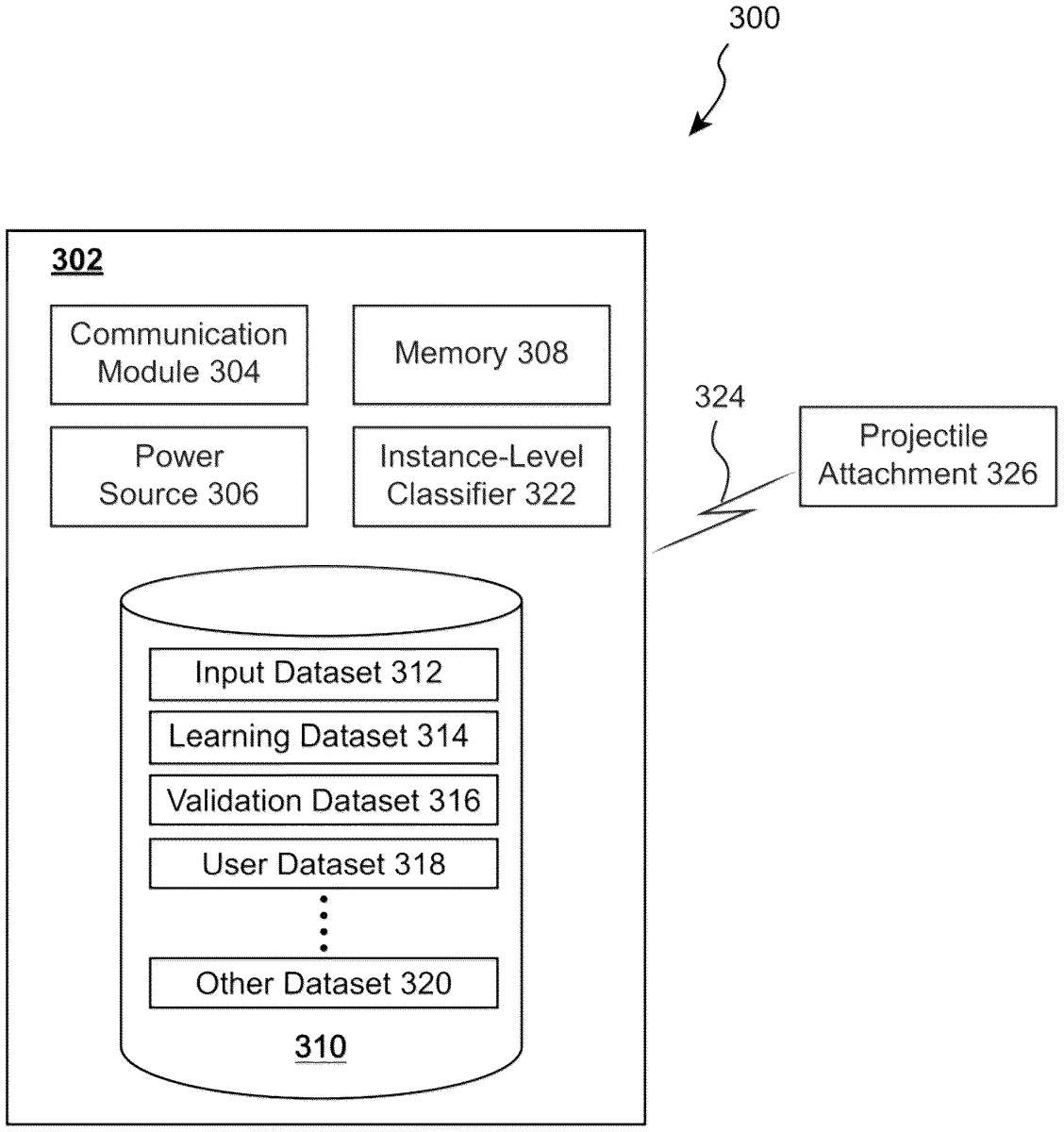
1 . An automated system ( 300 ) for monitoring a projectile launcher, the automated system comprising: a sensor module ( 202 ), configured to be coupled with the projectile launcher to acquire signals and convert the signals into time-sampled data; a communication module ( 226 ) configured to receive a shooting plan ( 404 ) and send the time-sampled data corresponding to the shooting plan ( 404 ) using the sensor module ( 202 ); and a processing module ( 302 , 412 ) configured to receive and process the time-sampled data from the communication module ( 226 ) to generate a monitoring model ( 434 ), wherein the processing module ( 302 , 412 ) is further configured to: produce at least one shot candidate ( 420 ) from the time-sampled data when at least one metric ( 418 ) is satisfied, deploy an instance-level classifier ( 322 , 422 ) to categorize the at least one shot candidate ( 420 ) to generate at least one prediction ( 424 ), compute an estimated proportion ( 426 ) by aggregating the at least one prediction ( 424 ), compare the estimated proportion ( 426 ) with a real proportion ( 428 ) to determine a loss function ( 430 ), and generate the monitoring model ( 434 ) through an iterative process until a predetermined minimal loss is achieved. a sensor module ( 202 ), configured to be coupled with the projectile launcher to acquire signals and convert the signals into time-sampled data; a communication module ( 226 ) configured to receive a shooting plan ( 404 ) and send the time-sampled data corresponding to the shooting plan ( 404 ) using the sensor module ( 202 ); and a processing module ( 302 , 412 ) configured to receive and process the time-sampled data from the communication module ( 226 ) to generate a monitoring model ( 434 ), wherein the processing module ( 302 , 412 ) is further configured to: produce at least one shot candidate ( 420 ) from the time-sampled data when at least one metric ( 418 ) is satisfied, deploy an instance-level classifier ( 322 , 422 ) to categorize the at least one shot candidate ( 420 ) to generate at least one prediction ( 424 ), compute an estimated proportion ( 426 ) by aggregating the at least one prediction ( 424 ), compare the estimated proportion ( 426 ) with a real proportion ( 428 ) to determine a loss function ( 430 ), and generate the monitoring model ( 434 ) through an iterative process until a predetermined minimal loss is achieved. produce at least one shot candidate ( 420 ) from the time-sampled data when at least one metric ( 418 ) is satisfied, deploy an instance-level classifier ( 322 , 422 ) to categorize the at least one shot candidate ( 420 ) to generate at least one prediction ( 424 ), compute an estimated proportion ( 426 ) by aggregating the at least one prediction ( 424 ), compare the estimated proportion ( 426 ) with a real proportion ( 428 ) to determine a loss function ( 430 ), and generate the monitoring model ( 434 ) through an iterative process until a predetermined minimal loss is achieved.
Google Patents
https://patents.google.com/patent/US12523438
USPTO PDF
https://image-ppubs.uspto.gov/dirsearch-public/print/downloadPdf/12523438