US12372320 - Systems and techniques for testing a gun
guntestingsimulationmechanism
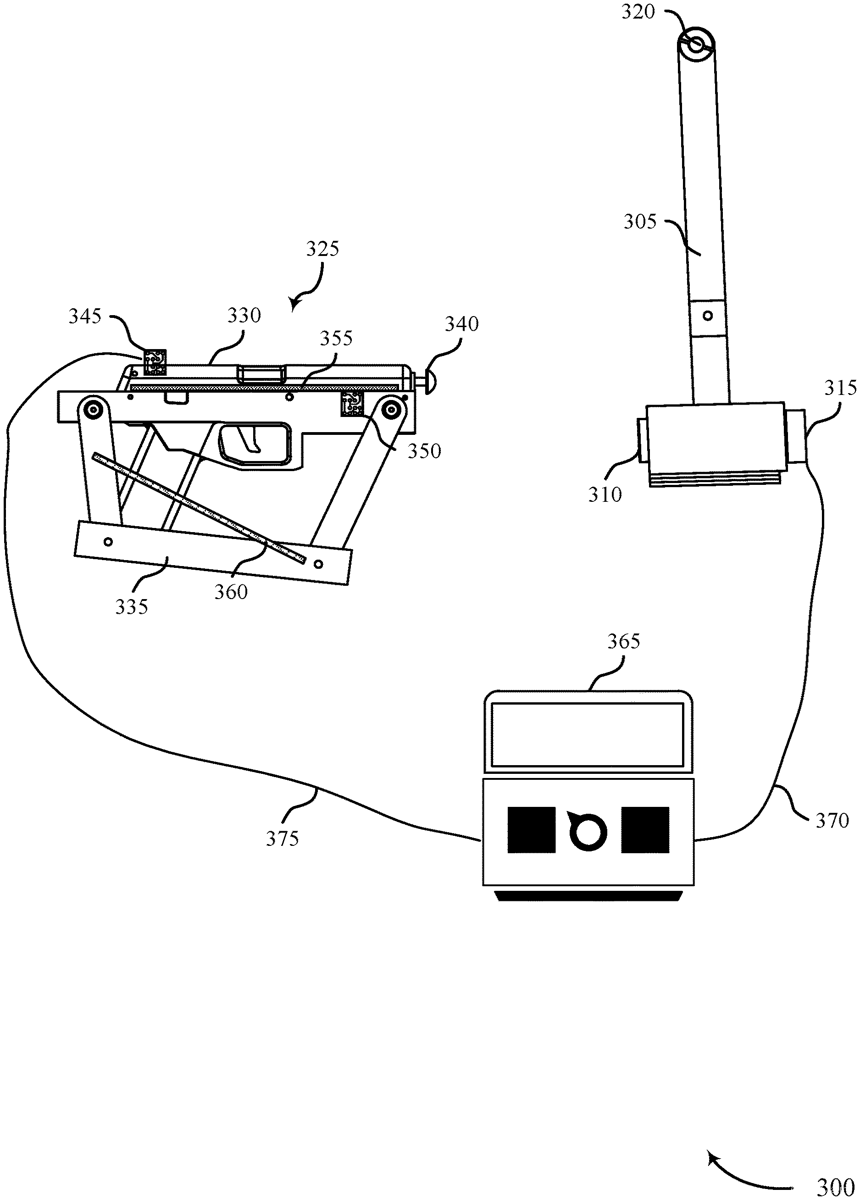
The patent describes a system for testing firearms by simulating the firing of live ammunition using a striking mechanism and compressible rods to apply force to the gun. This system includes an attachment mechanism to hold the gun in place and a controller to process the force data generated during the simulation.
Claim 1
- A system for applying force to a component of a gun so as to simulate firing live ammunition, the system comprising: an attachment mechanism including two or more linkage components that are mechanically coupled, wherein the attachment mechanism stably holds the gun in a predetermined orientation; a backstop mechanism coupled with the attachment mechanism such that the backstop mechanism is able to accommodate planar movement of the attachment mechanism, wherein the backstop mechanism permits movement of the attachment mechanism based on (i) a dynamic spring rate and (ii) a stroke length that together simulate movement of the gun while a user is gripping the gun, and wherein the dynamic spring rate and/or the stroke length are configurable to allow for simulation of different types of grips that the user could employ; a striking mechanism that has (i) a distal end at which both a force sensor and a first compressible rod are situated and (ii) a proximal end about which the distal end is able to pivot, wherein the distal end of the striking mechanism is configured for displacement along an arcuate path of travel between a first position and a second position; a second compressible rod located within a barrel of the gun and against a breechface of the gun; a motor configured to actuate the striking mechanism from the first position to the second position to increase gravitational potential energy of the striking mechanism so that, when released, gravity causes the distal end of the striking mechanism to pivot about the proximal end of the striking mechanism so as to initiate a collision with the first compressible rod of the striking mechanism and the second compressible rod located within the barrel of the gun held in the attachment mechanism, wherein a distance between the second location and the gun is greater than a distance between the first location and the gun; and a controller configured to: convert an analog signal that is generated by the force sensor in response to the collision into a digital signal, and store the digital signal in memory. an attachment mechanism including two or more linkage components that are mechanically coupled, wherein the attachment mechanism stably holds the gun in a predetermined orientation; a backstop mechanism coupled with the attachment mechanism such that the backstop mechanism is able to accommodate planar movement of the attachment mechanism, wherein the backstop mechanism permits movement of the attachment mechanism based on (i) a dynamic spring rate and (ii) a stroke length that together simulate movement of the gun while a user is gripping the gun, and wherein the dynamic spring rate and/or the stroke length are configurable to allow for simulation of different types of grips that the user could employ; a striking mechanism that has (i) a distal end at which both a force sensor and a first compressible rod are situated and (ii) a proximal end about which the distal end is able to pivot, wherein the distal end of the striking mechanism is configured for displacement along an arcuate path of travel between a first position and a second position; a second compressible rod located within a barrel of the gun and against a breechface of the gun; a motor configured to actuate the striking mechanism from the first position to the second position to increase gravitational potential energy of the striking mechanism so that, when released, gravity causes the distal end of the striking mechanism to pivot about the proximal end of the striking mechanism so as to initiate a collision with the first compressible rod of the striking mechanism and the second compressible rod located within the barrel of the gun held in the attachment mechanism, wherein a distance between the second location and the gun is greater than a distance between the first location and the gun; and a controller configured to: convert an analog signal that is generated by the force sensor in response to the collision into a digital signal, and store the digital signal in memory. convert an analog signal that is generated by the force sensor in response to the collision into a digital signal, and store the digital signal in memory.
Google Patents
https://patents.google.com/patent/US12372320
USPTO PDF
https://image-ppubs.uspto.gov/dirsearch-public/print/downloadPdf/12372320